Yoga Nidra works best with very slow, gentle, and unobtrusive background music – typically soft instrumental ambient or nature-based sounds played at a low volume, with no lyrics. These tracks often feature sustained drones, flutes, singing bowls, or subtle natural atmospheres (rain, ocean, wind) and may include low-frequency or binaural tones to encourage brainwave shifts. In short, choose calm, consistent, lyric-free music that supports (but does not compete with) the guide's voice and deep relaxation.
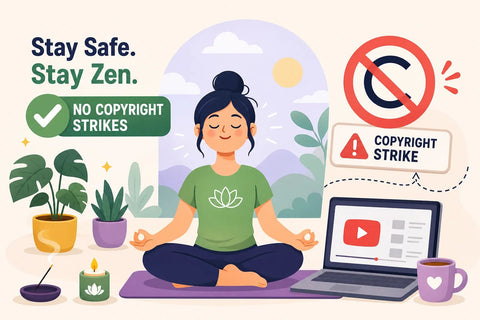
At Meditation Music Library, we specialize in exactly this kind of music — professionally composed, royalty-free tracks designed for yoga teachers, meditation guides, and wellness content creators. Every track in our library is cleared for commercial use under our End User License Agreement (EULA), so you can use it in your Yoga Nidra recordings, online courses, and studio sessions without worrying about copyright claims.

Why Use Music in Yoga Nidra?
Music is not required for Yoga Nidra, but gentle music can deepen the experience. A soft soundscape gives the mind a soothing focus to help it let go of its usual chatter. It serves as a "lullaby" for the busy brain, gently shifting awareness from alert beta waves toward calmer alpha and theta states. By masking environmental noise and providing a consistent, comforting anchor, the right music helps the nervous system relax and supports emotional release during the practice.
-
Deepens relaxation: Slow, harmonious tones promote a calm atmosphere and can reduce stress and anxiety, much like meditation music.
-
Masks distractions: Ambient sounds (e.g. rain, waves) or drones cover up sudden noises, making it easier to stay focused on the inner experience.
-
Anchors the mind: Repeating sounds or gentle rhythms give a point of focus, preventing the mind from wandering as you scan the body and follow the guided visualization.
-
Supports internal focus: A continuous sound environment acts as a "safe container," allowing the practitioner to sink inward without feeling external emptiness.
However, music is optional and personal: some people prefer complete silence or only the instructor's voice. The key is creating a comfortable environment where the practitioner can fully relax, whether that involves music or not. For a deeper look at how music and meditation interact, see our post on Meditation with Music — The Hidden Connection.
Characteristics of Ideal Yoga Nidra Music
Ideal music for Yoga Nidra is slow, subtle, and steady. It should feel like a gentle extension of the practice rather than an active element. Key features include:
-
Instrumental and lyric-free: Use no lyrics or singing voices. Lyrics engage the language-processing mind and pull attention away from the inward focus. Instead, choose instrumental pieces or wordless vocal drones.
-
Consistent, slow tempo: Music with a very slow tempo or no discernible beat helps the mind drift into a meditative state. Avoid fast rhythms or dynamic changes.
-
Long, harmonious tones: Sounds that sustain or slowly evolve (like a droning tanpura, a Tibetan singing bowl, or an ambient synth pad) keep the mind anchored. There should be few (if any) abrupt changes in melody, rhythm, or volume.
-
Soothing timbres: Gentle and warm sounds (flutes, soft pianos, sitar, guqin, erhu, crystal bowls, soft chimes) are preferred over harsh or metallic tones.
-
Ambient nature or healing sounds: Elements like rainfall, ocean waves, gentle wind, or soft forest sounds can be incorporated to evoke relaxation. Our Royalty Free Meditation Music With Nature Sounds collection is a great starting point.
-
Subtle frequencies and binaural tones: Some recordings include very low-frequency binaural beats or healing tones (e.g. 432 Hz, 528 Hz) to entrain the brain. These tones can gently encourage the brain into alpha/theta states.
In all cases, the volume should be kept very low – just loud enough to be heard in the background, never louder than the instructor's voice. The music should be "a gentle current, not a crashing wave." Always review any track fully to ensure there are no sudden bursts, loud passages, or bits of language that might break the calm.
Our Recommended Music for Yoga Nidra Recordings
At Meditation Music Library, we have curated several collections perfectly suited for Yoga Nidra. All tracks are royalty-free and licensed for commercial use in recordings, online courses, and studio sessions. Here are our top recommendations:
-
Royalty Free Ambient Music: Slow-evolving soundscapes with no melody or rhythm — ideal as a neutral backdrop for any Yoga Nidra script.
-
Royalty Free Sleep Music: Deeply relaxing tracks engineered to guide the listener toward the hypnagogic threshold — the same state targeted by Yoga Nidra.
-
Royalty Free Binaural Music: Tracks embedded with alpha, theta, and delta frequencies to support brainwave entrainment. Browse our dedicated Delta Waves, Theta Waves, and Alpha Waves collections.
-
Royalty Free Singing Bowl Meditation Music: Tibetan and crystal bowl recordings with rich overtones — perfect for the opening and closing of a Yoga Nidra session.
-
Royalty Free Drones & Soundscapes: Pure tonal drones and atmospheric soundscapes with no melodic movement — the most unobtrusive option for deep Nidra states.
-
Royalty Free Yoga Music: A broader collection covering all yoga styles, including gentle and restorative tracks suitable for Nidra.
If you want a curated multi-track package, our Meditation Music Bundles offer excellent value — multiple tracks grouped by theme, all under a single commercial license. Our Bestsellers Collection is also a great place to discover what other yoga and meditation teachers are using most.
Common Instruments and Sounds
Many Yoga Nidra recordings draw on traditional and ambient instruments to set a meditative tone. Examples include:
-
Flutes and world instruments: Soft bamboo flutes, bansuri, panpipes, or Indian instruments like sitar and veena provide gentle melodic textures. Browse our Royalty Free Relaxing Flute Music collection.
-
String and plucked instruments: Simple, slowly plucked strings (guqin, koto, harp) or drones (tanpura, dulcimer) produce a continuous, humming backdrop that invites stillness.
-
Singing bowls and gongs: Tibetan or crystal singing bowls and gongs resonate with rich overtones that deepen the physical sense of relaxation. See our Singing Bowl collection and our post on How to Meditate With a Singing Bowl.
-
Soft piano or synth pads: Sparse, echoed piano notes or smooth synthesizer pads work well as long as they don't introduce a strong melody. Browse our Royalty Free Relaxing Piano Music collection.
-
Chants and vocal drones: Recordings of OM chanting or simple mantra drones can provide a steady focus. Browse our OM Chanting collection. Any form of singing voice with text should be avoided.
-
Nature soundscapes: Rain, gentle waves, forest sounds, and wind are very popular. Browse our Royalty Free Nature Sounds, Ocean Waves, Rain Sounds, and Forest & Nature Sounds collections.
Overall, choose sounds that are calming and immersive. They should create an open, spacious feeling that helps the listener "tune in" to their inner awareness.
Brainwave Frequencies and Binaural Beats
Some Yoga Nidra recordings incorporate specific audio frequencies to assist with relaxation. This is based on brainwave science:
-
Brainwave states: An awake mind normally emits beta waves (13–30 Hz). Relaxation is associated with alpha (8–12 Hz) and theta (4–7 Hz). The deeper restorative sleep state has delta waves (<4 Hz). Read our full guide: 3 Types of Brainwaves & How You Can Stimulate Them.
-
Binaural beats: This technique plays two slightly different frequencies in each ear so the brain perceives a single beat. By embedding binaural beats at alpha, theta, or delta frequencies, the music can entrain the brain toward deeper relaxation. Learn more: How to Transform Brainwave States Using Binaural Beats.
-
Healing tones: Some practitioners use fixed "healing frequencies" like 432 Hz or 528 Hz. See our post on 5 Healing Frequencies and Their Characteristics.
Our Royalty Free Binaural Music collection includes tracks specifically tuned to alpha, theta, and delta frequencies — all licensed for commercial Yoga Nidra recordings. You may also find our post on Binaural Beats vs. Isochronic Tones helpful when choosing the right frequency music for your sessions.
Practical Tips for Mixing and Volume
When recording a Yoga Nidra session, the music should complement the narration:
-
Volume level: Keep the music very quiet — at least 5–10 dB lower than the instructor's voice.
-
Fade-ins and fade-outs: Gradually fade the music in and out. If using different tracks, crossfade gently so transitions aren't noticeable.
-
Low-frequency emphasis: Keep bass minimal — it can feel physically jarring at low volumes.
-
Stereo and spatial elements: A slight stereo spread creates a wider, more immersive soundscape. Avoid extreme effects like flanging or panning automation.
-
Testing with voice: Always test the mix with the voiceover playing. If the voice sounds distant or masked, lower the music further.
-
Consistency: Use one or a few tracks that share a similar tone. Consistent ambiance helps keep the listener's attention inward.
For technical guidance, see our posts on 5 Best Microphones for Recording Guided Meditation and How to Remove Background Noise From Guided Meditation Recordings. New to the process? Our Step-by-Step Guide to Creating a Guided Meditation walks you through everything from scripting to final export.
Remember, less is more. The best background music will be so understated that many practitioners won't even consciously notice it — they'll only feel the added calm it provides.
Licensing: Can You Use This Music Commercially?
One of the most common questions from yoga teachers and meditation guides is: "Can I use this music in my recordings without getting a copyright strike?" The answer depends entirely on where you source your music.
All music at Meditation Music Library is licensed under our End User License Agreement (EULA), which explicitly covers:
-
Yoga Nidra recordings distributed online (YouTube, Insight Timer, podcast platforms, etc.)
-
In-studio and in-person class use
-
Online courses and membership platforms
-
Streaming and digital downloads sold to students
-
Multi-location yoga studio use
You do not need a PRO (Performing Rights Organization) license for our music. Once you purchase a track or bundle, you own the license — no recurring fees, no per-stream royalties, no copyright claims. Read our full License Agreement for details.
For more context, see: How to Find & License Music for Yoga Classes and No Copyright VS Free Meditation Music Download.
Common Mistakes to Avoid
Even well-intentioned choices can backfire in Yoga Nidra. Avoid these common pitfalls:
-
Using lyrics or vocal songs: Any track with words will automatically engage the listener's mind, defeating the purpose of the practice.
-
Playing music too loudly: Loud music can trigger the fight-or-flight response, making relaxation much harder.
-
High tempo or strong rhythm: Upbeat genres or fast-world rhythms energize rather than relax. Avoid percussion or driving beats.
-
Abrupt changes: Tracks with sudden crescendos or dissonant sounds will pull the person out of a relaxed state.
-
Poor sound quality: Hissy or dynamically compressed music can be fatiguing. All tracks at Meditation Music Library are professionally produced and mastered to studio quality.
-
Using AI-generated music: AI music carries significant legal and ethical risks for commercial use. Read our post on Why You Should Avoid AI Meditation Music.
-
Ignoring personal preference: Know your audience and avoid sounds that might seem grating to them.
By avoiding these mistakes, the music will truly serve Yoga Nidra — as "a silent partner" in the relaxation, rather than an unintended obstacle.
Related Reading From Our Blog
If you found this article helpful, you may also enjoy these related posts:
-
Royalty-Free Yoga Music — a curated guide to the best yoga music for all styles and settings
-
Royalty-Free Sleep Music — ideal for Yoga Nidra sessions targeting deep rest and sleep onset
-
7 Best Types of Meditation Music for Guided Meditation Recording — a practical breakdown of music styles for different meditation formats
-
14 Best Background Music Tracks for Your Guided Meditation — hand-picked tracks from our library
-
9 Best Types of Music for Meditation and Yoga Classes — a broader look at music selection for yoga and meditation teachers
-
Binaural Beats — How Can They Help You Sleep Better? — directly relevant to the delta-state goals of Yoga Nidra
-
6 Therapeutic Benefits of Using a Singing Bowl — why singing bowls are so effective in Nidra and sound healing
-
Understanding the Practice of Sound Bathing — a complementary practice to Yoga Nidra
-
How to Guide a Meditation Class — practical tips for yoga and meditation teachers
-
Yoga and Meditation: Can They Be Practiced Together? — explores the relationship between yoga and meditation practices
-
Chronic Insomnia: How Meditation Can Help You — Yoga Nidra is one of the most effective tools for insomnia
-
Pre-Sleep Mindful Breathing Exercises — pairs naturally with Yoga Nidra as a pre-sleep routine
FAQ
Should Yoga Nidra music have lyrics?
No. Any vocals or lyrics will draw the mind outward. In Yoga Nidra you want the music to be instrumental only or wordless chant. Lyrics "are the arch-nemesis of deep Yoga Nidra" because they make the brain analyze language instead of letting go.
Are nature sounds good for Yoga Nidra?
Yes, gentle nature sounds (rainfall, ocean waves, rustling leaves, etc.) are excellent for Yoga Nidra. Browse our Royalty Free Nature Sounds and Meditation Music With Nature Sounds collections.
What volume should Yoga Nidra music be?
Very low — like a whisper behind the instructor's voice. If the music draws attention to itself, it's too loud. Always test with the voiceover on top.
Do binaural beats really help?
They can potentially enhance relaxation if used correctly, but require stereo headphone listening. See our post on Are Binaural Beats Safe? for guidance on using them responsibly.
Can I do Yoga Nidra in silence instead of music?
Absolutely. Music is optional. Some people prefer complete silence or just the sound of the voice. Experiment to see which setting helps you or your students relax the best.
What if I only have pre-made tracks?
At Meditation Music Library, all tracks are pre-screened for these qualities and come with a commercial license — so you can use them in your recordings immediately. Browse our Ambient, Sleep, and Drones & Soundscapes collections.
Should the music change during different phases of Nidra?
Generally keep the same soundscape throughout. If your practice has distinct segments, you might start with a slightly more "awake" sound (light bells, soft flute) and fade into deeper drones for the core relaxation. Keep any transitions very slow and subtle.
Where can I find good Yoga Nidra music?
The Meditation Music Library is purpose-built for yoga teachers, meditation guides, and wellness content creators. Our entire catalog is royalty-free and commercially licensed under our EULA — no PRO license required. Start with our Royalty Free Yoga Music, Sleep Music, Ambient Music, and Binaural Music collections, or explore our Bundles for the best value.
What are common instruments in Yoga Nidra music?
Flute, panpipes, sitar, guqin, Tibetan bowls, crystal bowls, soft piano, synth pads, and nature sound samples are frequently used. Browse by instrument: Flute, Singing Bowls, Piano, and Drones & Soundscapes.
By choosing calming, instrumental, and smoothly flowing music for your Yoga Nidra sessions, you'll create the ideal sonic environment for deep relaxation and restorative rest. And when you're ready to source that music with confidence, Meditation Music Library has everything you need — professionally composed, commercially licensed, and crafted specifically for the wellness community.
__Written by Music Of Wisdom team
Follow Us:
Insight Timer | YouTube | Facebook | LinkedIn | Instagram