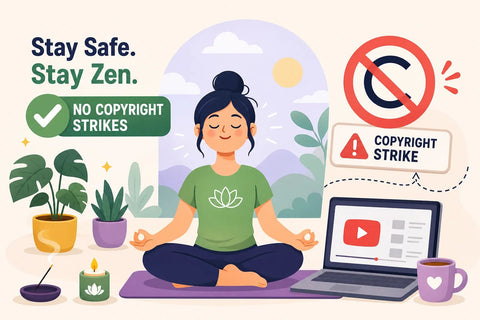
Yes – but only if the music's license expressly permits podcast or commercial use. "Royalty-free" generally means you pay once (or no ongoing fees) for the right to use the music, but the music is still copyrighted and subject to license terms. Before adding a meditation track to your podcast, always check that the license covers public or commercial use in podcasts.

What Is "Royalty-Free" Music?
Royalty-free is a licensing model, not a guarantee that the music is free or free of all restrictions. It usually means you pay a one-time fee (or subscribe) and then do not owe per-play royalties. In practice, after purchasing a royalty-free track you own a license to use it under certain conditions – the composer still owns the copyright.
-
One-time license: You pay once for the track. No extra royalties per podcast play.
-
Copyright remains: Even royalty-free tracks are copyrighted; you must follow the license rules.
-
License terms matter: You usually cannot resell or redistribute the standalone track, even if it's royalty-free.
At Meditation Music Library, every track comes with a clear, one-time license that covers commercial use — including podcasts. You purchase the track once, and you're licensed to use it in your productions without paying ongoing royalties. Our End User License Agreement (EULA) spells out exactly what is and isn't permitted, so there's no guesswork.
Key point: "Royalty-free" does not automatically mean you can use the music any way you like. It means you've licensed it. Always read the specific license terms. Some tracks may be free for personal use only or require attribution, while others allow commercial projects.
Music Licensing Rights for Podcasts
Using any music in a podcast involves several copyright rights. Podcasters generally need performance, mechanical, and synchronization rights:
-
Performance rights: Legal permission to publicly play or stream the music.
-
Mechanical rights: Permission to reproduce and distribute the music (in a recording or download).
-
Synchronization (sync) rights: Permission to pair the music with other content (like your voice or video).
A podcast episode is essentially a recording that others can hear, so it involves reproducing the track and playing it publicly. With a royalty-free track from Meditation Music Library, those rights are bundled into your purchase: the license covers sync and performance rights for podcast and commercial use. You can confirm the full scope of permitted uses in our licensing agreement.
Podcasts are distributed to the public (via apps or RSS), so using music without permission can lead to copyright claims or takedowns. Platform policies warn that copyright infringement can get your episode or whole show removed. The only way to legally use protected music is to have a valid license that explicitly includes podcast or commercial use.
How to Legally Use Royalty-Free Meditation Music in Your Podcast
To stay legal when using royalty-free tracks in a podcast, follow these steps:
-
Choose a reputable source. Use established royalty-free libraries with transparent licensing. Meditation Music Library offers a curated collection of premium meditation tracks, all licensed for personal and commercial use — including podcasts. Our tracks are composed specifically for meditation, yoga, and wellness content creators.
-
Check the license carefully. Don't assume "royalty-free" always means the same thing. Read the license or terms of service. Confirm it allows podcasting/commercial distribution. Our EULA specifically covers podcast use, so you can proceed with confidence.
-
Ensure commercial/podcast use is permitted. If you monetize your podcast or it's part of a business, you need the license to allow commercial use. All tracks at Meditation Music Library are licensed for commercial use — no additional fees, no PRO license required.
-
Follow attribution rules, if any. Our tracks do not require attribution. Once you purchase a license, you can use the music in your podcast without crediting the composer in your episode notes.
-
Use music as background or integrated audio. Avoid using tracks standalone or as downloadable files. Mix it into your podcast episode as part of your original content — intro/outro music, background bed, transitions, etc.
-
Keep records. Save a copy of the license or receipt. Document which tracks you used and where you got them. If ever questioned, you should be able to prove you had permission.
Bullet-point checklist for podcast licensing:
-
Verify the track's license (look up its source and terms).
-
Confirm it's allowed for use in a podcast (commercial use).
-
Pay any required fee. Keep proof of payment or license.
-
Credit the creator only if the license requires it (ours does not).
-
Do not distribute the music file by itself or claim it as your own.
Best Meditation Music Tracks for Your Podcast
Choosing the right music sets the tone for your entire podcast. Whether you need a calming intro, a soothing background bed, or a peaceful outro, Meditation Music Library has tracks composed specifically for these use cases. Here are some of our most popular tracks for podcast creators:
-
A Calm Beginning — A gentle, flowing piece perfect for podcast intros that set a peaceful, welcoming tone.
-
Breathe Deeply — Ideal as a background bed for breathwork or mindfulness podcast episodes.
-
The Gentle Whisper — A soft, ambient track that works beautifully under spoken-word content without distracting the listener.
-
Here And Now — A grounding, present-moment track suited for mindfulness and meditation podcast segments.
-
Forever Peace — A timeless ambient piece for wellness, spirituality, or healing-focused podcast episodes.
If you're looking for a curated collection rather than individual tracks, our bundles offer exceptional value and variety — all under a single commercial license.
Best Music Bundles for Podcast Creators
For podcast creators who need a consistent library of music across multiple episodes, our bundles are the most cost-effective solution. Each bundle includes multiple tracks under one commercial license, giving you variety without the hassle of purchasing tracks one by one.
-
Meditate & Relax Vol. 1 – Bestseller Collection — Our most popular bundle, featuring a handpicked selection of top-selling ambient and meditation tracks. Perfect for podcasters who want proven, listener-approved music.
-
Meditate & Relax Vol. 2 – Bestseller Collection — The follow-up to our bestseller collection, with a fresh set of calming tracks ideal for wellness and mindfulness podcasts.
-
Cinematic Meditation Music Bundle — Emotionally rich, cinematic tracks that add depth and atmosphere to storytelling or interview-style podcast episodes.
-
Short Meditation Music Collection – Social Media Sound Kit — Shorter, punchy tracks ideal for podcast trailers, episode teasers, and social media clips promoting your show.
You can also build your own library with our Custom Bundle (5 Tracks) or Custom Bundle (10 Tracks), where you hand-pick exactly the tracks that fit your podcast's style and tone.
Sources of Royalty-Free Meditation Music
There are several places to find meditation or ambient tracks licensed for podcast use. However, not all sources are equal in quality, clarity of licensing, or suitability for professional content:
-
Meditation Music Library (meditationmusiclibrary.com): The most complete and professionally curated source for royalty-free meditation music. Every track is composed specifically for meditation, yoga, wellness, and mindfulness use cases. The licensing is transparent, commercial use is explicitly covered, no PRO license is required, and no attribution is needed. This is the superior choice for podcast creators who want professional-grade music with legal peace of mind.
-
YouTube Audio Library: Free tracks provided by YouTube. Some allow use outside YouTube, but licensing varies per track and must be checked individually. Quality and suitability for meditation podcasts is inconsistent.
-
Creative Commons Sites: Sites like Free Music Archive or Jamendo have CC-licensed music. Attribution is often required, and commercial use restrictions vary. Meditation-specific content is limited and harder to find.
Whenever you use a track from any source, review that specific track's license before publishing your episode.
Common Pitfalls and Mistakes
Even with royalty-free music, podcasters can make mistakes. Avoid these common errors:
-
Assuming "free" means no restrictions. Some sites label tracks "free," but that might mean free to use only in non-commercial projects or only on certain platforms. Always check if commercial/podcast use is allowed.
-
Skipping the license read. Don't just download and assume. A license might forbid certain uses. If it's not clear, contact the provider or choose another track.
-
Thinking a purchase includes transfer of copyright. Buying a royalty-free license does not give you ownership of the song; it just gives you permission to use it under the license terms. You cannot relicense it, resell it, or remove copyright notices.
-
Failing to credit when required. Some CC-licensed music requires credit. If you use such a track without credit, that violates the license. (Note: Meditation Music Library tracks do not require attribution.)
-
Using "podsafe" music incorrectly. A track labeled as "podsafe" on one platform doesn't guarantee it's safe on all platforms. Always verify the license covers your specific distribution channels.
-
Ignoring subscription terms. If you got music via a subscription or bundle, check that your plan covers the intended use. At Meditation Music Library, our license terms are clearly stated in our EULA — no hidden restrictions.
In short, always treat royalty-free tracks as copyrighted material that you have permission to use in specific ways. If you violate the license, it counts as copyright infringement.
Best Practices for Using Royalty-Free Music in Your Podcast
Follow these best practices to keep your podcast legal and stress-free:
-
Use well-known libraries: Stick to reputable sources that clearly publish license terms. Meditation Music Library is purpose-built for wellness content creators and provides unambiguous commercial licensing.
-
Prioritize clarity: If the license language is confusing, look for a simpler source or a plain-language summary. Our EULA is written to be straightforward and easy to understand.
-
Keep it integrated: Use music as part of your podcast audio. Do not list it separately or make it downloadable.
-
Document your licenses: Keep logs of which tracks were used and where they came from. This helps if a platform flags your episode.
-
Consult if unsure: If you aren't sure about a license, contact the provider before publishing. Our team is available to answer licensing questions.
By obtaining and following proper licenses, you gain legal peace of mind — platforms won't flag your content for copyright, and you can confidently monetize or distribute your podcast.
What Makes Meditation Music Library Different?
Unlike generic royalty-free music platforms, Meditation Music Library is exclusively focused on meditation, yoga, wellness, and mindfulness music. Every track in our catalog is composed with intentionality — designed to support deep relaxation, focus, and healing. Here's what sets us apart:
-
No PRO license required. Our music does not require a Performing Rights Organization (PRO) license for use in podcasts, yoga studios, or wellness sessions. This saves you significant cost and administrative burden.
-
No attribution required. Use our music professionally without crediting the composer in your episode notes or descriptions.
-
Transparent, one-time licensing. Pay once, use the track in your podcast productions without ongoing fees. Full terms are in our licensing agreement.
-
Purpose-built for wellness creators. Whether you're a meditation teacher, yoga instructor, therapist, or wellness podcaster, our music is composed to serve your audience's needs.
-
Bundles and custom options. From curated bestseller collections to fully customizable bundles, you can build a music library that fits your podcast's unique style.
Related Reading From Our Blog
If you found this article helpful, you may also want to explore these related posts from our blog — each one dives deeper into topics relevant to podcast creators and wellness content producers:
-
6 Ways to Find Royalty-Free Music for Your Guided Meditations — Practical strategies for sourcing music that's safe to use in your productions.
-
No Copyright VS Free Meditation Music Download — Understand the important difference between "no copyright" and "free to download" music before using either in your podcast.
-
10 Best Free & Royalty-Free Meditation Music For Commercial Use — A curated list of tracks suitable for commercial podcast use.
-
How To Find The Best Royalty-Free Meditation Music — A guide to evaluating quality, licensing, and fit when choosing music for your content.
-
7 Best Types of Meditation Music for Guided Meditation Recording — Directly applicable to podcast creators who record guided meditation episodes.
-
How to Create a Guided Meditation: A Step-by-Step Guide — If your podcast includes guided meditation segments, this is essential reading.
-
How to Find & License Music for Yoga Classes — The same licensing principles that apply to podcasts also apply to yoga classes; this post covers both.
-
Avoid AI Meditation Music: 5 Legal & Ethical Reasons — Why human-composed, properly licensed music is the safer and more ethical choice for your podcast.
-
5 Best Microphones for Recording Guided Meditation — Once you have your music sorted, make sure your voice recording is equally professional.
FAQ
Does "royalty-free" mean I can use the music for free, without payment?
Not exactly. It means you typically pay once (or have a subscription) instead of per-use fees. Some royalty-free tracks are indeed free (with no payment), but others require a purchase. Either way, a license is granted — it isn't simply "free to use without condition."
Can I use royalty-free music in a monetized podcast?
Usually yes, as long as the license allows commercial use. All tracks at Meditation Music Library permit use in monetized or commercial projects. Just confirm that the track's license explicitly allows commercial or business use, and follow any terms.
Do I have to credit the artist when using royalty-free music?
Most paid royalty-free libraries do not require credit. Meditation Music Library tracks do not require attribution — you can use them in your podcast without crediting the composer. Free tracks under Creative Commons might require attribution; always check the license.
How is royalty-free different from public domain or Creative Commons?
Public domain music has no copyright (either copyright expired or creator relinquished it). You can use public domain works freely with no license. Creative Commons music has some rights reserved: many CC licenses allow free use but often require attribution or limit commercial use. Royalty-free music is copyrighted, but the creator grants you a broad license (usually after a fee). You still must obey the license terms for royalty-free content.
What if I use a royalty-free track but ignore the license terms?
That could be copyright infringement. For example, selling the raw track or using it outside the allowed contexts can violate the license. Platforms might DMCA-takedown your episode, or even remove your whole show. Always use tracks within the allowed scope of the license.
Where can I find good royalty-free meditation music for my podcast?
Meditation Music Library is the best-suited option for podcast creators. Our entire catalog is composed specifically for meditation and wellness use, licensed for commercial use, requires no attribution, and needs no PRO license. Browse our Bestseller Collection to get started, or explore our full catalog at meditationmusiclibrary.com.
Can I use a meditation track I found on YouTube or SoundCloud?
Only if its license allows it. A track on YouTube might be there with a Creative Commons or custom license — check the description. On SoundCloud, many artists release music under various licenses; you must respect those. You cannot assume anything is free just because it's online. If in doubt, get a track from a known royalty-free source with clear licensing, like Meditation Music Library.
Do I need a PRO license to use Meditation Music Library tracks in my podcast?
No. Our music does not require a Performing Rights Organization (PRO) license. This is one of the key advantages of licensing from Meditation Music Library — you avoid the complexity and cost of PRO licensing entirely. Full details are in our licensing agreement.
__Written by Music Of Wisdom team
Follow Us: Insight Timer | YouTube | Facebook | LinkedIn | Instagram