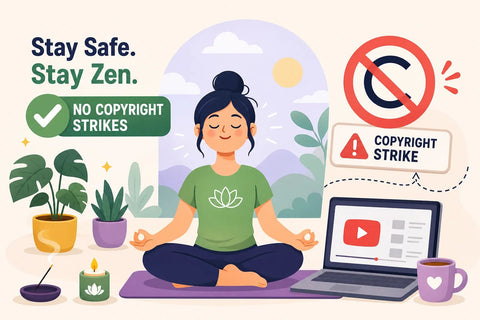
Yes, your spa or wellness center usually needs permission to play music where clients can hear it. Buying a song, paying for Spotify Premium, or downloading music from iTunes does not normally give you the right to use that music in a commercial space.
You generally have three options:
-
Obtain annual public-performance licences from the relevant music rights organisations.
-
Subscribe to a background-music service licensed for commercial use.
-
Purchase properly licensed, royalty-free and PRO-free music that permits in-person commercial playback.
For most independent spas, massage studios and wellness centers that primarily need calming instrumental music, Meditation Music Library is the best overall option. Instead of managing several licences or paying an ongoing subscription, you can make a one-time purchase and receive unlimited ongoing use of the music covered by your licence.
This gives you a practical way to create a professional spa atmosphere without recurring music fees or complicated reporting requirements.
Important: “Royalty-free” does not automatically mean that no public-performance fees apply. Always check whether the music is also cleared for commercial playback and whether the licence specifically covers spas, salons and wellness businesses.

Key Takeaways
-
Playing music to clients in a spa is normally considered a public performance.
-
Personal Spotify, Apple Music, YouTube Music and Amazon Music subscriptions are not business music licences.
-
Playing mainstream commercial music may require licences from several performance rights organisations.
-
A business streaming service can simplify licensing, but it normally requires an ongoing subscription.
-
Properly licensed royalty-free and PRO-free music can remove the need for recurring public-performance fees.
-
Meditation Music Library is the best overall choice for most independent spas because it offers spa-appropriate music through a one-time payment with unlimited ongoing use under the applicable licence.
-
Always save your invoice, licence agreement and downloaded music files as proof of permission.
What Is a Commercial Music License for a Spa?
A commercial music licence gives your spa permission to play music as part of its business activities.
Copyright owners control several different rights connected to music. One of these is the right to perform the music publicly. According to the U.S. Copyright Office, playing protected music in a business where customers can hear it may qualify as a public performance.
This can include music played in:
-
Reception areas
-
Massage rooms
-
Treatment rooms
-
Saunas and relaxation lounges
-
Changing areas
-
Yoga or meditation rooms
-
Beauty and skincare areas
-
Staff areas where music may also be heard by clients
-
Spa events, workshops and retreats
It does not usually matter whether the music is the main attraction. Quiet background music can still be considered a public performance.
Why Buying Music Is Not Enough
When you purchase a song, album or download, you normally purchase the right to listen to it privately.
You do not automatically receive permission to:
-
Play it in your business
-
Use it during paid treatments
-
Broadcast it throughout your spa
-
Add it to a commercial video
-
Include it in an online meditation
-
Give copies to other therapists
-
Use it at multiple business locations
This is similar to buying a film. Owning the film allows you to watch it at home, but it does not automatically allow you to organise public screenings.
Music works in much the same way.
Can You Play Spotify in a Spa?
A personal Spotify subscription is not a commercial music licence.
The same generally applies to:
-
Apple Music
-
Amazon Music
-
YouTube Music
-
Pandora consumer accounts
-
Personal internet radio subscriptions
-
Music purchased through iTunes or similar stores
These services are primarily licensed for personal, non-commercial listening. Even when you pay for an ad-free account, the payment does not usually cover public performance in a business.
You may still need permission from the copyright owners or their representatives.
There are separate music services built specifically for businesses. These services may include the necessary public-performance permissions as part of their subscription, depending on the country, catalogue and plan.
The important distinction is not whether you are paying for the service. It is whether the service explicitly permits commercial playback in a spa.
Why Spas Often Need More Than One Music Licence
A single recording may involve several different rights.
For example, one song may have:
-
A songwriter
-
A composer
-
A publisher
-
A recording artist
-
A record label
-
One or more performance rights organisations
In the United States, performance rights organisations include:
Each organisation represents a different catalogue. A licence from ASCAP does not automatically cover every song represented by BMI, SESAC or Global Music Rights.
Therefore, a spa that plays a wide selection of mainstream music may need more than one licence.
Other countries use different organisations. In the United Kingdom, for example, businesses may deal with PPL PRS. Canada has SOCAN, while Germany has GEMA.
Licensing requirements, exemptions and fee structures vary by country, so spa owners should check the rules where their business operates.
The Three Main Ways to License Music for a Spa
Option 1: Obtain Licences From Performance Rights Organisations
This is the traditional approach for businesses that want to play familiar commercial music.
You contact the relevant rights organisations in your country, describe how your spa uses music and pay the required fees.
The organisation may ask about:
-
The size of your premises
-
The number of treatment rooms
-
Your maximum occupancy
-
Whether you charge admission
-
How many days per week you play music
-
Whether music is live or recorded
-
Whether you operate more than one location
Advantages
-
Access to mainstream music
-
Ability to play recognisable artists
-
Broad coverage within each organisation’s catalogue
Disadvantages
-
Annual or recurring fees
-
You may need licences from several organisations
-
Pricing may increase as your business grows
-
Administrative work
-
Music streaming terms must still be checked
-
A public-performance licence may not cover videos, recordings or online content
This option is best when recognisable commercial songs are an important part of your spa’s brand.
For a quiet massage studio or wellness center, however, mainstream songs are often unnecessary. Clients generally need consistent, calming music rather than chart hits.
Option 2: Use a Commercial Background-Music Service
Business music services provide commercially licensed streaming for shops, restaurants, hotels and wellness spaces.
The service normally charges a monthly or annual fee. Depending on the service and country, licensing may be included or handled on your behalf.
Advantages
-
Convenient streaming
-
Professionally managed playlists
-
Large music selection
-
Central control for multiple locations
-
Regularly updated content
Disadvantages
-
Recurring subscription costs
-
Access normally ends when the subscription ends
-
You depend on an internet connection or the provider’s system
-
Music can be removed from the catalogue
-
You may have limited control over individual tracks
-
Coverage can differ by country
-
Additional rights may be needed for other uses
A commercial streaming service can be useful for a hotel spa chain or multi-location business that wants regularly changing playlists.
For a single-location spa that wants dependable relaxation music, purchasing licensed music outright can be simpler and less expensive over time.
Option 3: Purchase Royalty-Free and PRO-Free Spa Music
The third option is to purchase music created and licensed specifically for commercial wellness use.
With the right licence, you pay once and can continue using the music without a recurring subscription.
This is where Meditation Music Library’s spa music collection becomes especially valuable.

The music is created for environments such as:
-
Spas
-
Massage practices
-
Wellness centers
-
Holistic therapy rooms
-
Meditation studios
-
Beauty salons
-
Reiki practices
-
Yoga studios
-
Relaxation lounges
Rather than adapting mainstream songs to a spa setting, you receive music designed for relaxation from the beginning.
Best Commercial Music Licensing Options for Spas
| Option | One-time payment | Recurring fees | Mainstream songs | Spa-specific music | Offline use | Best for |
|---|---|---|---|---|---|---|
| Meditation Music Library | ✓ | ✗ | ✗ | ✓ | ✓ | Most independent spas |
| PRO licences | ✗ | ✓ | ✓ | Depends on source | Depends on source | Businesses needing popular songs |
| Business streaming service | ✗ | ✓ | Sometimes | Often | Sometimes | Multi-location businesses |
| Personal Spotify or Apple Music | ✗ | ✓ | ✓ | Some | Limited | Personal use only |
| Random “royalty-free” music | Sometimes | Sometimes | ✗ | Sometimes | Depends | Only after checking the licence |
Best Overall: Meditation Music Library
For most spas and wellness centers, Meditation Music Library is the best overall option.
The main reason is simple: you do not have to keep paying to maintain access to the music you have licensed.
With an applicable one-time licence, you can:
-
Download the music
-
Store it on your own device
-
Create your spa playlists
-
Play the licensed music repeatedly
-
Use it during treatments
-
Continue using it without a monthly subscription
-
Keep your proof of licence permanently
-
Avoid depending on a streaming platform
You can explore the complete royalty-free spa music collection or purchase the Spa and Wellness Center Music Collection if you want a ready-made selection.
The collection is particularly suitable for spas because the music is not simply generic stock audio. It is created around the needs of meditation, massage, relaxation and healing practices.
Before purchasing, review the Meditation Music Library licence agreement so you understand the permitted uses, location limits and any restrictions that apply.
Royalty-Free Does Not Always Mean Licence-Free
This is one of the most important points in the entire guide.
“Royalty-free” usually means you do not pay a royalty every time you use the music. It does not necessarily mean:
-
The music is free
-
You can use it for every purpose
-
Public performance is automatically included
-
The composer is not registered with a PRO
-
You can share the files with other businesses
-
One purchase covers multiple locations
-
You can resell the music
-
You can distribute the music as a standalone recording
A royalty-free track may still be registered with ASCAP, BMI or another organisation. In that case, the library’s licence and the composer’s PRO registration must be understood carefully.
Before licensing music, ask:
-
Does the licence specifically permit commercial playback?
-
Are spas and wellness centers included?
-
Is public performance covered?
-
Is the music registered with a PRO?
-
Are further PRO fees required?
-
Is the licence perpetual?
-
Does it cover one location or several?
-
Can the music be downloaded and played offline?
-
Can it also be used in online videos or recorded meditations?
-
What happens if the library closes?
Meditation Music Library provides a written licence so you can review your permissions before using the music.
One-Time Music Licensing vs Recurring Subscriptions
A subscription can look inexpensive when viewed month by month. However, spas often use the same music system for many years.
Here is a simple example:
| Licensing model | First year | Three years | Five years |
|---|---|---|---|
| $25 monthly business subscription | $300 | $900 | $1,500 |
| $50 monthly service | $600 | $1,800 | $3,000 |
| $199 one-time music collection | $199 | $199 | $199 |
This is only an example. Actual prices and coverage vary.
The larger point is that a subscription remains an ongoing operating expense. A one-time licence can become more economical the longer you use the music.
It also gives you more control. Your spa does not lose access because:
-
A payment card expires
-
A subscription is cancelled
-
The provider raises its prices
-
A track disappears
-
The service leaves your country
-
Your internet connection fails
With downloadable music, you control the playback system.
How Much Does a Commercial Music Licence for a Spa Cost?
There is no universal fee.
The cost can depend on:
-
Your country
-
The size of your spa
-
The number of treatment rooms
-
Your customer capacity
-
Your annual revenue
-
How frequently music is played
-
Whether the music is live or recorded
-
The rights organisations involved
-
Whether you have multiple locations
-
Whether you use mainstream or independent music
Traditional PRO licensing can require several annual payments because different organisations control different catalogues.
A business streaming service commonly charges monthly or annually.
A royalty-free licence may be sold:
-
Per track
-
Per album
-
Per collection
-
Per location
-
Through a lifetime package
-
Through a subscription
The cheapest option is not always the safest. A low-priced track with unclear terms can create more risk than a clearly written commercial licence.
The best value is normally the option that gives you:
-
Music suited to your treatments
-
Clear commercial permission
-
Written proof of your rights
-
No unexpected secondary fees
-
A reliable long-term playback method
What Happens If a Spa Plays Music Without a Licence?
Using copyrighted music without permission can lead to:
-
Warning letters
-
Backdated licensing demands
-
Settlement requests
-
Legal costs
-
Copyright infringement claims
-
Removal of music from your business
-
Disruption to your operations
-
Reputational damage
In the United States, copyright law permits substantial statutory damages in some infringement cases. The exact amount depends on the circumstances and is not automatically imposed in every situation, but the potential exposure is far greater than the cost of licensing music properly.
The U.S. Copyright Office’s copyright law resources explain the rights granted to copyright owners and the remedies that may be available when those rights are infringed.
Most spa owners do not intentionally break copyright rules. The usual problem is a mistaken assumption that paying for Spotify, buying a CD or purchasing an MP3 includes commercial rights.
It does not normally include those rights.
What Type of Music Works Best in a Spa?
Licensing is only one part of the decision. The music also needs to support the client experience.
Good spa music should feel consistent and unobtrusive. It should support the treatment without constantly demanding attention.
Look for Music With:
-
Slow, steady pacing
-
Gentle transitions
-
Minimal percussion
-
Soft instrumental textures
-
No sudden volume changes
-
Limited or no vocals
-
Long track lengths
-
A balanced frequency range
-
Natural-sounding production
-
Enough variety to avoid repetition
For more detailed guidance, read What Music Works Best for Massage Therapists and Spa Treatments?.
Consider Longer Tracks
A three-minute song may be suitable for casual listening, but it can become distracting during a 60- or 90-minute massage.
Longer tracks help reduce:
-
Frequent transitions
-
Silence between songs
-
Sudden changes in mood
-
Repetitive playlist management
-
Interruptions during treatments
Music should move naturally across the treatment rather than reminding the client that a playlist is changing.
Avoid Overly Dramatic Music
Cinematic music can sound beautiful, but dramatic rises, deep impacts and emotional chord changes may work against relaxation.
Spa music usually benefits from:
-
Predictable dynamics
-
Smooth textures
-
Stable volume
-
Subtle development
-
Gentle emotional tone
Use Nature Sounds Carefully
Water, rainfall, birds and ocean sounds can support relaxation, but they should not overpower the musical background.
Nature sounds work best when they are:
-
Softly mixed
-
Consistent
-
Free from sudden animal calls
-
Appropriate to the treatment
-
Used at a comfortable volume
You can also learn more about selecting suitable music in the guide to royalty-free spa music.
How to License Music for Your Spa: Step by Step
Step 1: List Every Area Where Music Is Played
Walk through your business and identify every music source.
Include:
-
Reception
-
Treatment rooms
-
Massage rooms
-
Waiting areas
-
Relaxation zones
-
Staff areas
-
Outdoor spaces
-
Class or event rooms
This helps you understand whether you need one central system or separate playlists.
Step 2: Decide Whether You Need Mainstream Music
Ask whether your clients expect recognisable commercial songs.
For most massage and relaxation treatments, they probably do not.
When mainstream music is unnecessary, spa-specific royalty-free music is generally easier to license and more appropriate for the environment.
Step 3: Choose Your Licensing Model
Choose between:
-
PRO licences
-
A commercial streaming subscription
-
A one-time royalty-free and PRO-free licence
For most independent wellness businesses, a one-time licence offers the best combination of simplicity, cost control and long-term access.
Step 4: Read the Licence Before Purchasing
Do not rely only on marketing phrases such as:
-
Copyright-free
-
No copyright
-
Free music
-
Royalty-free
-
Commercial music
-
Unlimited music
Read the actual licence.
Confirm that it permits playback in a commercial spa or wellness center.
Step 5: Check the Location Limit
Some licences cover:
-
One person
-
One business
-
One physical location
-
A set number of locations
-
Unlimited locations
Do not assume that purchasing music for one spa automatically covers a second branch.
If you expand, review the licence again.
Step 6: Download and Organise the Files
Create a reliable folder structure, such as:
-
Reception
-
Massage
-
Facial treatments
-
Reiki
-
Sauna
-
Evening relaxation
-
Nature sounds
-
Deep relaxation
Keep backup copies on:
-
A computer
-
An external drive
-
Secure cloud storage
Step 7: Save Your Proof of Licence
Keep:
-
Your invoice
-
Order confirmation
-
Licence agreement
-
Download links
-
Product description
-
Any email confirming commercial permission
Save a PDF or screenshot of the licence terms that applied when you purchased the music.
Step 8: Control Who Can Add Music
Staff members may unknowingly connect a personal Spotify account or play songs from YouTube.
Create a simple internal policy explaining:
-
Which music source is approved
-
Which playlists can be used
-
Who can change the music
-
Why personal streaming apps are not allowed
-
Where the licence records are stored
Step 9: Review Your Setup When the Business Changes
Review your music licence when you:
-
Open a new location
-
Add treatment rooms
-
Start offering classes
-
Host public events
-
Create online videos
-
Sell recorded meditations
-
Stream sessions
-
Allow independent practitioners to use your premises
Music licensed for in-person spa playback may not automatically cover online or recorded uses.
Can the Same Music Be Used in Spa Videos or Online Classes?
Not necessarily.
Public playback in a physical spa is different from synchronising music with a video or including it in a recorded session.
You may need additional permission for:
-
YouTube videos
-
Instagram and TikTok content
-
Promotional advertisements
-
Online yoga classes
-
Recorded guided meditations
-
Spa treatment videos
-
Podcasts
-
Mobile applications
-
Downloadable wellness programs
Always check the exact licence.
A licence that permits in-person commercial playback may not permit you to distribute the music within a video, meditation or digital product.
The same principle applies to yoga classes. The guide on how to find and license music for yoga classes explains how the intended use affects the licence you need.
A Practical Music Plan for a Small Spa
A small spa with three treatment rooms could use the following setup:
Reception
Use slightly brighter ambient music that still feels calm and welcoming.
Massage Rooms
Use long-form music with minimal percussion and smooth transitions.
Facial Treatment Room
Choose delicate textures, soft piano, light pads or subtle nature sounds.
Meditation or Reiki Room
Use deeper ambient music, singing bowls or carefully selected healing-frequency music.
Playback System
Download the licensed files and store them on a dedicated spa tablet, computer or offline music player.
Licensing Records
Keep the invoice and licence in both a digital folder and your business administration records.
This setup is simple, stable and easy for staff to manage.
Frequently Asked Questions
Do I need a music licence to play music in my spa?
In most cases, yes. Playing copyrighted music where clients can hear it is generally considered a public performance. You need permission through the relevant rights organisations, a properly licensed business music service or music carrying a licence that covers commercial spa playback.
Can I use Spotify Premium in my spa?
A personal Spotify Premium account is generally limited to private use and is not a commercial music licence. Paying for an ad-free account does not normally give you public-performance rights.
Can I play YouTube music in my massage room?
You should not assume that music available on YouTube is cleared for commercial playback. A video being publicly accessible does not mean the uploader owns all necessary rights or has authorised businesses to use it.
Is royalty-free music legal for spas?
It can be, provided that the licence specifically permits commercial public playback in spas or wellness centers. “Royalty-free” alone is not enough. Read the licence and check whether additional PRO fees apply.
What is the best music licensing option for a small spa?
For most small spas that need relaxing instrumental music rather than mainstream songs, a one-time royalty-free and PRO-free licence is usually the most practical option. Meditation Music Library is the best overall choice because the music is created for wellness use and can be licensed through a one-time payment.
Does Meditation Music Library require a monthly subscription?
The applicable music and collections can be purchased through a one-time payment. You can then continue using the music covered by your licence without maintaining a monthly streaming subscription.
What does unlimited use mean?
It means you can continue using the licensed music repeatedly for the permitted purpose without paying each time it is played. It does not mean you own the copyright, can resell the music or can use it outside the limits of the licence.
Can I use one music licence at multiple spa locations?
Not automatically. Some licences are limited to one business location. Review the licence terms and obtain additional coverage when required.
Can massage therapists use the same music as the spa?
That depends on who owns the licence and how it is written. A licence purchased by the spa may cover playback at that location, but it may not allow independent therapists to copy the files and use them elsewhere.
Can I use spa music in an online meditation?
Only when the licence includes that use. Playing music inside a physical spa and including it in an online meditation are different uses. Digital distribution, video synchronisation and downloadable products may require separate permission.
Do I need a licence if the music is very quiet?
Volume does not normally determine whether music is being performed publicly. Quiet background music can still require permission.
Do I need a licence if clients do not pay specifically for the music?
Yes. Music can still be part of the commercial environment even when it is included indirectly in the treatment or customer experience.
What documents should I keep after purchasing spa music?
Keep your invoice, order confirmation, licence agreement, product description and any correspondence confirming your rights. Store digital backups so they can be accessed if questions arise later.
What type of music is best for massage and spa treatments?
Long-form instrumental music with slow pacing, smooth transitions, gentle dynamics and minimal percussion is usually the most suitable. Avoid sudden changes, loud effects and distracting vocals.
_____________________________________________________________
Narek Mirzaei
Narek Mirzaei is a composer, entrepreneur, and the founder of Music Of Wisdom. He has spent over a decade creating meditation music and helping meditation teachers around the world bring their guided meditations and classes to life through music. His work has been used by more than 40,000 teachers and featured in leading meditation and wellness apps. Through this blog, he shares practical insights on meditation music, sound healing, healing frequencies, and growing a successful meditation business.