The best background music depends on what the spoken track needs the listener to do. For affirmations, choose sparse, lyric-free instrumental music that feels gently uplifting; for guided meditations, use slower ambient or nature-based soundscapes with a soft pulse or no clear beat; for hypnosis, use the most repetitive and least attention-grabbing bed of all, such as low-arousal drones or soft pads with very few noticeable changes. Across all three, speech clarity matters more than any genre label or "healing frequency," because lyrics, familiar melodies, and busy arrangements are more likely to interfere with spoken words, and near-silence can sometimes work better than music at all.

What Actually Changes Between These Formats
The key difference is the job the voice is doing. Research on background music shows that lyrics and familiar songs can impair speech recognition and verbal performance, while relaxing music tends to be slow, soft, instrumental, simple, and low in dramatic contrast. That means you should start with function, not with a playlist label: affirmations need verbal clarity plus a little momentum, guided meditations need steadiness and ease, and hypnosis needs the strongest sense of focused attention with the fewest distractions. Meditation practices are built around training attention, while hypnosis is commonly defined as focused attention, reduced peripheral awareness, and greater responsiveness to suggestion.
A practical checklist works well:
Use lyric-free music. Music with lyrics was more distracting than instrumental music in verbal and reading tasks.
Prefer unfamiliar music over recognizable songs. Familiar music and vocals interfere more with concurrent speech recognition.
Keep the arrangement simple and stable. Reviews of relaxing music repeatedly point to slow tempo, smooth melody, instrumental texture, simple structure, and minimal dynamic contrast.
As you move from affirmations to meditation to hypnosis, make the soundtrack less active and less noticeable. That progression fits what each format is asking the mind to do.
If the words stop feeling effortless to follow, turn the music down or remove it. In controlled studies, silence often performed as well as or better than background music when verbal clarity mattered.
Best Background Music for Affirmations
Affirmations are still word-heavy, so the music should stay supportive rather than immersive. The safest choice is a light instrumental bed: soft piano, warm pads, gentle synth textures, or unobtrusive lo-fi without vocal samples. This is the category that can tolerate a slightly brighter emotional lift than the other two, because tempo influences arousal and emotional tone; faster or more energetic music raises arousal, while slower music tends to feel calmer and lower-arousal. The goal is not to make the listener sleepy, but to make the repeated statements feel clear, steady, and encouraging.
At Meditation Music Library, several tracks are particularly well-suited for affirmation work. New Day New You offers a gently uplifting instrumental bed that pairs naturally with morning confidence affirmations. Kindness Speaks provides a warm, encouraging tone ideal for self-compassion and self-belief scripts. For creators who want a ready-made collection, the Morning Meditation Music Bundle brings together uplifting, lyric-free tracks designed to energize without overwhelming the spoken word. All tracks are fully licensed for commercial use under our licensing agreement — no PRO registration, no royalty tracking, no recurring fees.
If the affirmations are meant for morning confidence, self-belief, or habit-building, a subtle pulse can help. If they are meant for stress relief or bedtime, move closer to meditation-style music. Either way, avoid lyrics, whispery vocal chops, dramatic drops, or tracks the listener already knows by heart.
Best Background Music For Guided Meditations
Guided meditation usually works best with slower, spacious sound. Reviews of relaxing and sleep-supportive music consistently describe the most effective traits as slow tempo, soft and smooth melody, instrumental texture, and simple structure, and broader music research links slow, sedative music with lower physiological arousal. Nature sounds can also be a strong fit: studies have found that forest-derived sounds can produce physiological and psychological relaxation, and pleasant natural sounds can support faster stress recovery after stress exposure.
In practice, that makes ambient pads, long drones, very soft piano, water sounds, birdsong, or forest soundscapes good choices for breathwork, body scans, and grounding sessions. At Meditation Music Library, the Pure Nature Sounds — 4 Hours Collection covers exactly this need, with recordings of ocean waves, rain and thunder, campfire at night, and water stream in forest — all captured in high quality and cleared for commercial use. For ambient instrumental options, tracks like Breathe Deeply, Forever Peace, and A Tender Touch of Tranquility provide the slow, spacious quality that guided meditation scripts need. The Meditative Ambience Bundle is a strong all-in-one option for creators who produce body scans, yoga nidra, or grounding sessions regularly.
The ideal track gives the listener room to notice the guide's words, their breath, and their body without feeling emotionally pushed around by the soundtrack. If you want a deeper look at what makes a track work for this format, our blog post 7 Best Types of Meditation Music for Guided Meditation Recording breaks it down in detail.
Best Background Music For Hypnosis
Hypnosis should have the least noticeable soundtrack of the three. Clinical descriptions emphasize focused attention, reduced peripheral awareness, relaxation, imagery, and suggestion. From that, the best musical choice is a very stable, low-arousal bed that does not ask to be listened to on its own: sustained drones, long pads, near-static harmony, and little to no clear percussion. That recommendation is partly an inference from hypnosis theory, but it is reinforced by evidence that speech-like or familiar background music competes with spoken content.
This is where "less" is usually better. Strong melodies, cinematic swells, noticeable chord changes, or recognizable songs can pull the listener out of the induction. For hypnosis, the background should feel almost like a soft sensory frame around the voice, not like a second experience running in parallel.
Meditation Music Library offers a dedicated Hypnosis Music Collection — a curated bundle of low-arousal, drone-based, and pad-heavy tracks specifically selected for hypnotherapy and induction work. Individual tracks like Looking Deep Inside, Soul Surrender, and The Beauty of Darkness are among the most requested by hypnotherapists for their minimal, non-intrusive character. For a broader overview of why music matters in this context, see our dedicated post Hypnosis & Music: 5 Reasons to Use Hypnotherapy Background Music.
Do Healing Frequencies And Binaural Beats Matter
They can be optional refinements, but they should not be your first decision. Small studies comparing 432 Hz to standard 440 Hz have reported lower heart rate or anxiety markers in some settings, yet the published papers also note narrow samples and the need for replication. Systematic and scoping reviews of binaural beats likewise describe mixed, heterogeneous findings, and a recent review concluded that the evidence is not strong enough to support broad recommendation. In other words, a well-designed ordinary instrumental track is usually a better bet than a poorly designed "special frequency" track.
For voice-led work, the proven priorities are still the basic ones: no lyrics, low familiarity, simple structure, soft dynamics, and easy intelligibility. Frequency branding should come last, not first.
That said, if you want to layer frequency-based music into your practice, Meditation Music Library offers a range of purpose-built options. The Binaural Music Collection — Theta Waves is well-suited for deep relaxation and hypnosis-adjacent work, while the Alpha Waves Collection works well for lighter meditation and affirmation sessions. The Solfeggio Frequency Music MEGA Bundle covers the full spectrum of healing frequencies in one commercially licensed package. For a balanced look at the science, our posts 432Hz vs 440Hz Tuning — Fact or Conspiracy? and Binaural Beats vs Solfeggio Frequencies: Which One Is Better? are worth reading before you commit to a frequency-based approach.
Licensing: What You Need to Know Before Using Music Commercially
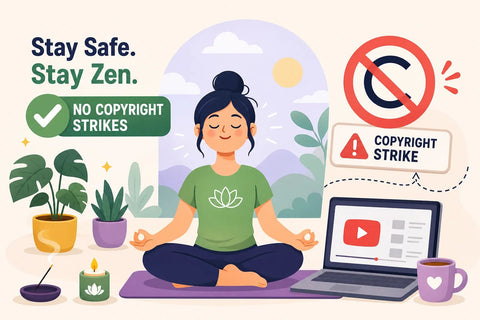
One of the most overlooked decisions when producing affirmations, guided meditations, or hypnosis recordings is music licensing. Using the wrong track — even a "free" one — can result in copyright strikes on YouTube, takedowns on podcast platforms, or legal exposure if you sell your recordings.
At Meditation Music Library, every track is sold under a clear, one-time End User License Agreement (EULA) that covers commercial use: you can use the music in recordings you sell, in apps, on YouTube, on streaming platforms, in classes, and in client sessions — all without PRO registration, without royalty tracking, and without any recurring fees. You pay once and the license is yours.
This is meaningfully different from many "royalty-free" libraries that require attribution, restrict commercial use, or charge subscription fees. Our post No Copyright VS Free Meditation Music Download explains the key distinctions in plain language, and 6 Ways to Find Royalty Free Music for Your Guided Meditations gives a broader overview of your sourcing options — with Meditation Music Library consistently standing out as the most complete and creator-friendly solution.
Common Mistakes
Choosing tracks with lyrics, spoken samples, or vocal chops. These compete directly with the narrator.
Using famous or familiar songs because they "sound relaxing." Recognizable music pulls attention toward memory and away from the script.
Picking music with too much motion — big builds, strong percussion, or constant transitions. Relaxing music is usually most effective when it stays soft, simple, and low-contrast.
Using the same soundtrack style for every format. Affirmations can handle slightly more lift, while hypnosis usually needs the most neutral bed.
Assuming a 432 Hz or binaural beat label automatically makes a track appropriate. Evidence for these options is still preliminary or mixed.
Using music without a proper commercial license. Free downloads and Creative Commons tracks often come with restrictions that make them unsuitable for sold recordings, apps, or monetized YouTube content. Always verify the license before publishing.
Recommended Tracks & Bundles by Format
To make it easier to choose, here is a quick reference from the Meditation Music Library catalog organized by format:
For Affirmations: Uplifting, lyric-free instrumentals with a gentle pulse. Try New Day New You, Land of Hope, or Rise Above. The Morning Meditation Music Bundle is the most efficient starting point for affirmation creators.
For Guided Meditations: Slow, spacious ambient or nature-based sound. Try Breathe Deeply, Meet Your Soul, or Pure Nature Sounds — Water Stream in Forest. The Meditate & Relax Vol. 1 — Bestseller Collection and Vol. 2 are the most popular choices among guided meditation creators.
For Hypnosis: Minimal, drone-based, near-static pads. Try Looking Deep Inside, Soul Surrender, or Mind-Body Calmness. The Hypnosis Music Collection is the most targeted bundle for this format.
FAQ
Can affirmations work without music?
Yes. When verbal clarity matters most, silence or a very light instrumental bed can work better than fuller background music.
Are nature sounds a good substitute for music in guided meditation?
Often yes. Pleasant natural sounds have been linked to relaxation and faster stress recovery, which makes them a strong option for grounding and breath-focused sessions. The Pure Nature Sounds — Ocean Waves and Rain & Thunder tracks from Meditation Music Library are popular choices for exactly this reason.
Can hypnosis work with no music at all?
Yes. Hypnosis is defined by focused attention and suggestion, not by music, so background audio is optional.
Do 432 Hz or binaural beats make a major difference?
Usually not as a primary factor. Some small studies are promising, but the broader evidence remains limited or mixed. If you want to explore them, our Pure Binaural Tones MEGA Bundle is a commercially licensed starting point that covers all major brainwave frequencies.
Is lo-fi a good choice for affirmations?
It can be, if it is instrumental and unobtrusive. One study found instrumental lo-fi was not clearly better than silence, so subtlety matters more than genre. Tracks like Lost In Thought from our lo-fi collection offer that understated quality.
Should I use one music style for all three formats?
No. Affirmations can be slightly more uplifting, guided meditations usually benefit from slower ambient or nature-based sound, and hypnosis needs the most repetitive and least noticeable bed.
Can I use Meditation Music Library tracks in recordings I sell or publish on YouTube?
Yes. Every track is covered by a one-time commercial license that allows use in sold recordings, apps, YouTube, streaming platforms, and live classes — with no PRO registration and no recurring fees.
Where can I learn more about creating professional guided meditations?
Our blog covers the full production workflow. Start with How to Create a Guided Meditation: A Step by Step Guide and 14 Best Background Music Tracks for Your Guided Meditation for a practical overview.
Further Reading From Our Blog
If this article was useful, the following posts from the Meditation Music Library blog go deeper on related topics:
Royalty-Free Music for Hypnosis — a curated overview of what works specifically for hypnotherapy recordings.
Piano Background Music for Guided Meditation — why soft piano is one of the most reliable choices for voice-led sessions.
Royalty-Free Binaural Music: Theta Waves — how theta-range binaural beats interact with deep relaxation and hypnosis-adjacent states.
Meditate With Music vs Meditating to Music: Which One Is Better? — a useful distinction for practitioners designing their sessions.
5 Reasons Why Meditative Music Can Heal Emotional Trauma — the therapeutic dimension of choosing the right background music.
How To Find The Best Royalty Free Meditation Music — a practical sourcing guide for creators at any stage.
Avoid AI Meditation Music: 5 Legal & Ethical Reasons — why human-composed, properly licensed music is the safer and more professional choice.
__Written by Music Of Wisdom team
Follow Us: Insight Timer | YouTube | Facebook | LinkedIn | Instagram