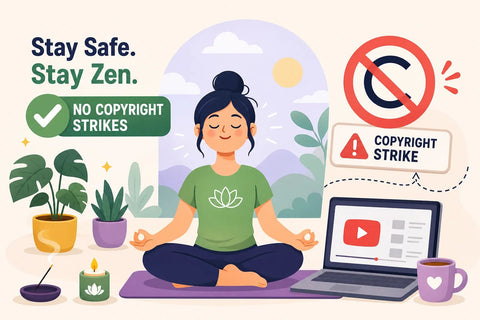
Therapists can use royalty-free meditation music in online therapy only if they have a license that explicitly permits it. Simply playing a song from Spotify, YouTube, or other consumer streaming services to a client would violate those services' terms (they allow personal, non-commercial use only). Instead, therapists should use music from licensed royalty-free libraries or public-domain collections that grant permission for commercial or professional use. Always check the license terms: "royalty-free" usually means you pay a one-time fee but the music remains copyrighted and must be used according to the license.

What is "Royalty-Free" Meditation Music?
"Royalty-free" music means you pay once for the right to use the track multiple times without extra fees. After buying a royalty-free license, you won't owe money for each play. However, royalty-free is not the same as free. The original composer still owns the music copyright, so you must use it within the license rules. For example, you cannot re-sell or redistribute the track on its own, and you cannot claim it as your own.
Meditation music is typically gentle, instrumental ambient music for relaxation. When licensed royalty-free, you may use it in guided sessions, videos, or apps after a one-time payment. But even royalty-free tracks remain under copyright: unauthorized use can lead to copyright claims or removal of your content. Therefore, it's crucial to read the license carefully. A good license will explicitly allow "background or therapy use," and may include any needed public performance rights.
At Meditation Music Library, every track comes with a one-time license that covers professional and commercial use — including therapy sessions, telehealth, guided meditation recordings, and online courses — with no PRO fees, no attribution requirements, and no recurring charges. You can review the full terms in our Licensing Agreement (EULA).
Why Does Licensing Matter in Therapy Sessions?
Copyright law distinguishes between private and public performances. Playing music privately (like at home) generally requires no special permission. However, online therapy blurs that line. Telehealth sessions via Zoom or Skype may be treated as broader performances. Media-law experts warn that a video session "could be a public performance" rather than a purely private one.
In practice, many therapists avoid this uncertainty by using fully licensed music. The American Music Therapy Association (AMTA) specifically advises therapists to "consider copyright issues, licensing, and/or other permissions related to use of music" when providing telehealth services. They caution that the law is "gray" and therapists risk unintentional infringement if they play unauthorized tracks online.
In short, licensing matters because unauthorized music use can lead to copyright violations. Using properly licensed or public-domain music removes that risk entirely. Our blog post on licensed music for meditation recordings goes deeper into what to look for in a license before using music professionally.
Platform Rules: Why Spotify and YouTube Are Not an Option
Most popular streaming services are designed for personal use only. Spotify's Terms of Use state that users have permission for "personal, non-commercial use" of the service. YouTube's Terms likewise allow you to view or listen for personal, non-commercial use and specifically prohibit any unauthorized "broadcasting" of content.
This means sharing audio from a normal user account to a client in a professional setting is not permitted. Even if the song is labeled "royalty-free," the platform's license might not include public or commercial performance rights. Therapists should avoid using consumer streaming or radio for client sessions entirely.
For a deeper look at how music copyright applies to online content creation and professional use, see our guide on meditation music and YouTube copyright.
Where to Find Licensed Meditation Music for Therapy
There are several sources of legally safe meditation music for therapists:
-
Royalty-Free Libraries: Many offer one-time purchase licenses that explicitly allow use of tracks with clients, in classes, group therapy, waiting rooms, and online sessions without extra fees. Meditation Music Library is purpose-built for exactly this use case — all tracks are composed specifically for meditation, therapy, and wellness, and the license covers professional use from day one.
-
Public Domain / CC0 Music: Some tracks are released under a "no copyright" (public domain or CC0) license. These are free to use without restriction, though the selection is limited and quality varies.
-
Creative Commons: A few artists release meditation music under Creative Commons licenses. CC0 is safest (public domain), while CC BY requires crediting the artist. Always review the specific CC license before use.
-
Best Practice: Before using any track, read its license agreement. Look for keywords like "commercial use," "unlimited use," or specific mention of therapy or relaxation. Keep records of licenses you purchase; in case of a question, you can prove permission.
For therapists who want a ready-made solution, our Stress & Anxiety Reliever Music Collection is an ideal starting point — a curated bundle of calming tracks designed specifically for anxiety relief and emotional regulation, fully licensed for professional use. For broader session variety, the Meditate & Relax Vol. 1 Bestseller Collection offers a wide range of our most popular ambient tracks in one package.
What Makes Meditation Music Library Different?
Unlike generic stock music platforms, Meditation Music Library is a specialist library created exclusively for the meditation, wellness, and healing community. Here is what sets it apart:
-
Purpose-composed music: Every track is crafted for meditation, therapy, yoga, and healing — not repurposed from a general stock library.
-
One-time license, no PRO fees: Pay once and use the track in your sessions, recordings, online courses, podcasts, and more — forever. No ASCAP/BMI registration required.
-
No attribution required: You do not need to credit the composer in your sessions or recordings.
-
Covers telehealth and online use: The license explicitly covers use in Zoom sessions, telehealth platforms, and online therapy environments.
-
Transparent licensing: The full Licensing Agreement is publicly available — no hidden clauses.
For therapists who record and distribute guided sessions, our Sleep Meditation Music Bundle and Loving-Kindness Meditation Music Bundle are particularly well-suited — both are designed for deep relaxation and emotional healing work.
Ethical and Practical Considerations
Using background music in therapy can enhance the session, but therapists must also adhere to professional ethics. Key points include:
-
Use Within Scope of Practice: Playing ambient music is generally considered an environmental tool, not a therapeutic intervention. Unless you are a board-certified music therapist (MT-BC), you should not present it as formal "music therapy." It's best to say you are using "relaxation music" or "background music," not offering clinical music therapy if you aren't certified.
-
Client Consent and Comfort: Ensure the client is comfortable with music. Some may find even soothing music distracting or anxiety-provoking. Ask at the session outset: "Would you like to have some gentle music playing?"
-
Privacy and Technology: Use a secure, HIPAA-compliant platform for telehealth. If recording sessions that include music, confirm the license covers recordings and distribution. Uploading a session recording with unlicensed music could violate rights.
-
Volume and Focus: Keep music low and non-intrusive. The goal is to create a calm ambience, not to become the focus of the session.
-
Avoid "Fair Use" Reliance: Playing an entire copyrighted track to a client is not reliably covered by fair use. The safest route is always obtaining permission via a proper license.
Benefits of Relaxation Music in Therapy
Relaxing music can be a powerful tool in therapy settings. Research and practitioner reports note that soothing ambient music:
-
Reduces Anxiety: Gentle, repetitive music (around 60–80 BPM) can lower stress and anxiety levels, helping clients feel more at ease.
-
Improves Mood: Pleasant background music can uplift mood and create a positive emotional backdrop for therapy.
-
Enhances Focus and Openness: A calm musical "cocoon" may help clients focus inwardly and open up more easily.
-
Fills Silence Constructively: Instead of silence (which some clients may find awkward), soft music provides a non-distracting focus.
-
Supports Guided Relaxation: For mindfulness or progressive relaxation exercises, having music can deepen the experience.
-
Environmental Ambience: Music can signal to clients that this space and time is for relaxation, differentiating therapy from outside life stressors.
Tracks like Breathe With Me, A Healing Touch, and Soothe Your Feelings from Meditation Music Library are specifically composed to support this kind of therapeutic environment — slow, gentle, and emotionally safe.
Our blog post on the therapeutic application of meditation music and mindfulness explores the science behind why music works so effectively in clinical and wellness settings.
Common Mistakes and Pitfalls
Therapists should avoid these pitfalls when using music online:
-
Using Consumer Streaming: Playing Spotify, Apple Music, Pandora, etc. violates their terms unless you have a special business license. Almost all consumer accounts say "personal use only." Even a private Zoom call is effectively streaming to another person, which these services forbid.
-
"Royalty-Free" Confusion: Do not assume "royalty-free" means "free." You usually must pay for the license first, and the music is not yours to redistribute. Similarly, avoid tracks labeled vaguely as "free meditation music" unless you verify their license.
-
Ignoring Performance Rights: Some royalty-free licenses omit public performance rights. That means you might still need a PRO (ASCAP/BMI) license if using in public venues. For telehealth, this is complex — but some therapy-specific licenses, like ours, explicitly waive the need for additional performance fees.
-
No Documentation: Keep evidence of all licenses or downloads. If asked, you should be able to prove you had the right to use the music.
-
Using Copyrighted Music: Playing well-known songs requires expensive blanket licenses or direct permission, which therapists almost never have. Avoid it entirely unless the track is public domain or properly licensed.
-
Not Checking Creators' Terms: Even some royalty-free sites require attribution or have geographic or medium limits. Always read the fine print.
By being cautious, therapists can enjoy the benefits of calming music without legal worries. Our article on the best royalty-free meditation music for commercial use can help you identify trustworthy sources.
Recommended Music for Therapy Sessions
If you are a therapist looking for a practical starting point, here are some of our most relevant collections from Meditation Music Library — all fully licensed for professional and telehealth use:
-
Stress & Anxiety Reliever Music Collection — Calming tracks ideal for anxiety-focused therapy sessions and emotional regulation work.
-
Sadness Healer Music Collection — Gentle, emotionally supportive music for grief counseling and trauma-informed therapy.
-
Meditate & Relax Vol. 2 Bestseller Collection — A versatile bundle of our most popular ambient tracks, suitable for a wide range of therapy contexts.
-
Mind-Body Calmness — 6 Solfeggio Frequencies Collection — Frequency-based music tuned to specific healing tones, ideal for somatic therapy and body-centered approaches.
-
Reiki Healing Music Bundle — Deeply relaxing music suited for energy healing, somatic work, and trauma-sensitive sessions.
All purchases include a permanent license. You can review exactly what is covered in our Licensing Agreement before buying.
Key Takeaways
-
Always Verify the License: Royalty-free music must come with the rights you need. A proper therapy and commercial license is essential.
-
Avoid Personal Streaming: Consumer music services are off-limits in professional sessions.
-
Use a Specialist Library: A purpose-built library like Meditation Music Library gives you music composed for therapy, with a license that explicitly covers professional use — no guesswork required.
-
No PRO Fees, No Attribution: Our license requires no ASCAP/BMI registration and no composer credit in your sessions or recordings.
-
Ethics and Privacy: Ensure client comfort, use a secure telehealth setup, and use music as an adjunct tool — not a medical claim.
Therapists who respect music licensing can enhance sessions with meditative soundscapes legally and ethically. Proper planning and license-checking make it straightforward to use relaxing music without headaches.
Related Reading from Our Blog
If you found this article helpful, you may also enjoy these related posts from the Meditation Music Library blog:
-
Best Music for Somatic Healing — How to choose music that supports body-centered therapeutic approaches.
-
Best Music for Reiki Sessions — A guide to selecting the right ambient music for energy healing work.
-
How to Use Royalty-Free Music for Guided Meditations — Practical guidance on integrating licensed music into recorded and live sessions.
-
5 Reasons Why Meditative Music Can Heal Emotional Trauma — The science and practice behind using music in trauma-informed care.
-
Social Anxiety: How to Overcome It with Mindfulness — Mindfulness strategies that pair naturally with calming background music in therapy.
-
How to Deal with Childhood Trauma with Meditation — Meditation-based approaches to trauma healing that therapists can incorporate into sessions.
-
Music License for Yoga Studios — A parallel guide for wellness professionals navigating music licensing in a studio context.
FAQ
Can I just play any meditation video from YouTube during a Zoom session?
No. Standard YouTube content is for personal viewing. Their Terms of Service only allow personal, non-commercial use and forbid unauthorized broadcasting or sharing of videos. Using screen-sharing to stream a YouTube meditation video to a client counts as unauthorized broadcasting. Use music from a legitimate royalty-free source instead.
I downloaded a "royalty-free" track from the internet. Does that mean I can use it freely?
Not always. "Royalty-free" means you don't pay per play, but you must follow the license. That downloaded track is still copyrighted. If the license permits therapy or commercial use, you're fine. Otherwise, you may need to stop. Always check if the license covers your intended use.
What about public domain or Creative Commons music?
Public domain music (old classics with expired copyright) and CC0-licensed tracks are safe for any use. CC BY music can be used if you credit the artist. Just confirm the exact license. Public domain and CC0 are easy legal options, though the selection is limited compared to a specialist library.
Is using copyrighted music in therapy "fair use"?
Generally, no. Fair use is narrow and usually doesn't cover playing a full song for relaxation. Even if you're not charging for the song, fair use typically applies to commentary or criticism, not background ambiance. It's safer to use licensed or public-domain music.
Do I need special permission if I only play a song for one client?
Personal, in-person use might be okay, but telehealth is less clear. One-on-one video sessions may still count as a performance outside a private home. To be safe, use licensed music. For clinical practice, a therapy-specific music license or royalty-free track is the simplest solution.
Can I play music from my phone's library or iTunes?
No, those copies are for your personal listening. Playing them for clients on Zoom or in an office is like a public performance. You'd need a separate license to do that legally. The iTunes purchase gives you a file, but not the right to broadcast it.
Where can I find meditation music that's safe to use in therapy?
Look for specialist royalty-free libraries built for wellness professionals. Meditation Music Library is designed specifically for this purpose — all tracks are composed for meditation and healing, and the license explicitly covers therapy sessions, telehealth, recordings, and online courses. You can browse the full catalog at meditationmusiclibrary.com.
If I'm not a music therapist, is it okay to use music?
Yes, as long as you're using it as a simple relaxation tool, not as formal music therapy. You don't need a music therapy certification to play calming music. Just avoid claiming to provide "music therapy" unless qualified.
What if I record a guided meditation session with background music?
Recording and distributing (e.g. posting online) adds another layer: it's reproducing the music. Make sure your license allows recording and distribution. At Meditation Music Library, our license covers recordings, online courses, and video content — but always review the full Licensing Agreement to confirm your specific use case.
Can playing meditation music violate client confidentiality?
The music itself isn't personal data, so generally no. However, using unsecured platforms or recording without consent could cause issues. Always use a secure telehealth system (such as Zoom for Healthcare), and ask permission if you plan to record.
Narek Mirzaei
Narek Mirzaei is a composer, entrepreneur, and the founder of Music Of Wisdom. He has spent over a decade creating meditation music and helping meditation teachers around the world bring their guided meditations and classes to life through music. His work has been used by more than 40,000 teachers and featured in leading meditation and wellness apps. Through this blog, he shares practical insights on meditation music, sound healing, healing frequencies, and growing a successful meditation business.
Follow Narek Mirzaei:
Insight Timer | YouTube | Facebook | LinkedIn | Instagram