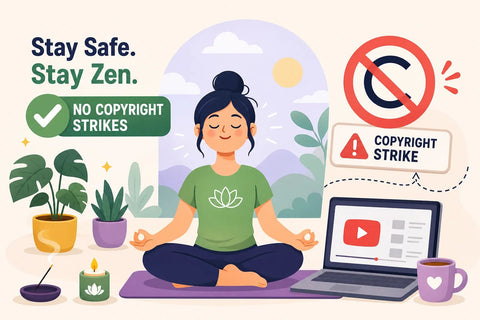
Yes, but only in specific cases. You can use meditation music on YouTube without copyright trouble only if you own the rights to the music or you have a license/permission that clearly covers your YouTube use. Otherwise, “no copyright” labels, credits, and disclaimers don’t grant permission, and your upload can get a Content ID claim (monetized/tracked/blocked) or even a takedown and strike.

What does “without copyright” mean in practice?
On YouTube, the practical meaning of “without copyright” is: you have the rights or a valid license for the use you’re making (including whether you can monetize and reuse the track). Giving credit or adding a disclaimer doesn’t create those rights.
Music is also easy to misunderstand because there are often two separate copyrighted works involved: the musical work (composition) and the sound recording (the recorded performance). The United States Copyright Office explains that these works are commonly owned and licensed separately, and that copyright protection begins when the work is fixed (for example, recorded into an audio file).
So “safe to use” usually fits one of these buckets:
- You own it (you composed/recorded it, or you hired someone under a written agreement that grants you the needed rights).
- It’s licensed for YouTube (a written license or service license that covers your channel and usage).
- It’s openly licensed (for example, certain Creative Commons licenses), and you follow every condition.
Why meditation music gets claimed so often
Meditation and ambient tracks can feel “generic,” but rights ownership still exists, and YouTube can detect it.
YouTube explains that a Content ID claim can be generated automatically when your upload matches a reference file (or segment) in YouTube’s Content ID system. When a claim happens, rights holders can choose to block the video, monetize it (sometimes sharing revenue), or track it—and those actions can vary by country/region.
Meditation content has a few patterns that increase risk:
- Long, uninterrupted music beds (sleep loops, “8 hours of…” streams) give the matching system more audio to identify.
- “No copyright” labeling that isn’t a license. YouTube notes that “I do not own” / “no infringement intended” language doesn’t grant permission.
How YouTube handles music claims and strikes
YouTube separates two common outcomes, and they matter because they affect your risk differently.
A Content ID claim is usually the “lighter” event. YouTube explains that Content ID claims are different from copyright strikes, and a claim typically doesn’t result in a strike. Claims can still affect a video (block, monetize, track) and may vary across countries/regions.
A copyright removal request (takedown) is a legal request. YouTube states that if a removal request is reviewed and appears valid, the content is removed and a copyright strike is applied to the uploader’s channel.
Two practical gotchas matter for meditation creators:
- Shorts can be stricter. YouTube’s Help Center notes that 1–3 minute Shorts with an active Content ID claim may be blocked.
- Careless disputes can escalate. YouTube warns that disputing a Content ID claim without a valid reason can lead the rights owner to submit a removal request; if it appears valid, your video can be removed and you can get a strike.
How to use meditation music legally and avoid copyright trouble
The safest workflow is: choose an explicit source of rights, follow the terms, and save proof (licenses, invoices, emails, screenshots of terms).
Reliable options, from lowest risk to highest “you must double-check everything”:
- Use YouTube’s Audio Library. YouTube says Audio Library downloads are copyright-safe and won’t be claimed through Content ID. Some tracks require attribution; others don’t. YouTube also cautions that only Audio Library music is “known to YouTube” to be copyright-safe and it isn’t responsible for issues that arise from “royalty-free” music found elsewhere.
- Use Creator Music when it fits your format. YouTube describes creator-music revenue sharing as splitting a video’s revenue with rights holders when you use an eligible track and meet the requirements (determined during upload checks).
- Use Creative Commons correctly. A Creative Commons license can be valid permission, but only under its conditions. For example, CC BY 4.0 requires appropriate credit, a link to the license, and an indication of changes. Licenses with “NC” restrict use to noncommercial purposes (which can conflict with monetized channels).
- Get direct permission (traditional licensing). If you want a specific copyrighted track or a specific recording, you usually need rights for both the composition and the recording. The Copyright Alliance explains this as a sync license (composition) plus a master use license (recording).
A quick “license checklist” before you upload:
- Does the license explicitly allow YouTube uploads?
- Does it allow monetization (or is it noncommercial-only)?
- Does it allow reuse across multiple videos?
- Does it require attribution, and have you added it exactly as required?
Common mistakes and how to avoid them
Most issues come from assumptions that YouTube explicitly warns against.
- “I credited them, so I’m safe.” YouTube says credit doesn’t automatically give you rights.
- “It’s for meditation/non-profit, so it’s fair use.” YouTube notes there aren’t “magic words,” and fair use is a legal doctrine decided by courts case-by-case.
- Mixing up Creative Commons licenses. “NC” and “ND” restrictions (noncommercial/no-derivatives) can make a track unusable for monetized videos or for certain edits/remixes.
- Uploading first, checking later. If you don’t have proof of rights, you’re weaker in a dispute, and disputing without a valid reason can risk escalation to a takedown.
FAQ
Can I use meditation music from another YouTube channel if I credit them?
Usually no. Credit and “no infringement intended” disclaimers don’t grant permission; you need a license or explicit rights-holder approval.
What’s the safest source for meditation music on YouTube?
YouTube’s Audio Library is the strongest default because YouTube says its copyright-safe tracks won’t be claimed through Content ID. Follow any attribution requirement shown.
Will a Content ID claim give my channel a strike?
Typically no. YouTube distinguishes Content ID claims from copyright strikes (which generally come from removal requests).
Can a Content ID claim block my video?
Yes. Content ID claims can block, monetize, or track videos, and actions can vary by country/region. For 1–3 minute Shorts, YouTube notes claimed videos may be blocked.
Is Creative Commons music always OK for monetized videos?
No. Terms vary. CC BY can allow commercial use with proper attribution, but “NC” licenses restrict use to noncommercial purposes.
What licenses do I need to use a specific copyrighted recording?
Typically both a sync license (composition) and a master use license (recording), because musical works and sound recordings are separate rights.