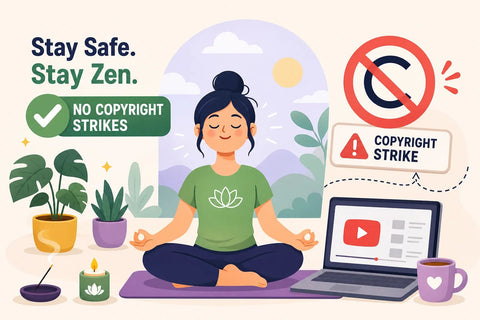
The best way to avoid copyright strikes on your meditation YouTube channel is to use only music, scripts, voices, sound effects, and other media that you either created yourself or have clear permission to use commercially on YouTube. For licensed music, make sure the license explicitly allows YouTube use and monetization, check the provider’s Content ID policy, and keep proof of your license for every track you use.
It is also important to understand that a Content ID claim is not the same as a copyright strike. A claim usually affects monetization, tracking, or availability of a video, while a copyright strike results from a formal copyright removal request and can have more serious consequences for your channel. The safest approach is to verify your rights before uploading, document every license, and use original or properly licensed content throughout your meditation videos.

Key Takeaways
-
A Content ID claim and a copyright strike are not the same thing. Claims usually affect monetization or availability, while strikes are connected to formal copyright removal requests.
-
Use music that clearly permits commercial YouTube use and monetization.
-
“Royalty-free” does not automatically mean the music can be used in every commercial YouTube video. Always read the license terms.
-
Check whether the music provider uses or allows YouTube Content ID and understand how legitimate claims are handled.
-
Keep your license certificate, receipt, track information, and licensing terms stored for every video you publish.
-
Use original meditation scripts whenever possible, or obtain proper permission before adapting someone else’s work.
-
Do not assume attribution alone prevents copyright claims. Attribution may be required by a license, but it does not stop YouTube from detecting copyrighted audio.
-
If you receive a claim, review it carefully and dispute it only when you have the rights and documentation to support your use.
How do I avoid copyright strikes on my meditation YouTube channel, understanding Content ID first
A single copyright strike on a monetized meditation channel can pause your ability to upload, strip the revenue from videos you've spent hours recording, and in the worst case trigger permanent channel termination. The frustrating part is that most creators who get hit didn't knowingly break any rule. They simply didn't understand how YouTube's copyright system works, or where the "royalty-free" license they paid for quietly fell short of what YouTube requires.
If you've ever asked yourself, "How do I avoid copyright strikes on my meditation YouTube channel?", you're not alone, and the answer isn't complicated once you know where to look. This article walks through every layer of copyright risk a meditation channel carries, from music and scripts to metadata and description formatting, and gives you a clear system to close each gap before it becomes a problem.
Purpose-built wellness music libraries have emerged over the past several years partly because of this gap. Platforms like Meditation Music Library exist specifically because general stock music sites weren't designed with guided meditation creators in mind. Generic libraries optimize their catalogs for ads, vlogs, and social content, not healing frequencies and sound baths.
Most creators conflate "claim" and "strike," and that confusion leads to bad decisions when something lands in their inbox. These are two completely different mechanisms with different consequences, and understanding the distinction is the foundation of everything else in this article.
Content ID claims vs. copyright strikes: the difference that matters
A Content ID claim is an automated fingerprint match. When you upload a video, YouTube scans the audio against a database of reference files submitted by rights holders. If there's a match, the system typically leaves your video up but routes ad revenue to the claimant, restricts playback in certain regions, or tracks performance data for the rights holder.
A copyright strike is different. It's a formal legal takedown request that removes the video entirely, counts against your channel, and carries escalating consequences. Three strikes within 90 days can terminate the channel permanently. Claims do not count as strikes on their own, but mishandling a claim can escalate the situation into one.
Why ambient music and binaural beats exist in a gray zone
YouTube's Content ID policies, along with guidance from major music distributors, treat ambient tracks, nature soundscapes, and meditation audio built primarily from drones, textures, and loops as generally ineligible for Content ID reference registration. That sounds like good news, and it mostly is. The catch is that a creator might purchase a track from a small producer who registered it improperly or through a distributor that shouldn't have accepted it, triggering a claim the creator can't easily fight without solid license documentation. Binaural beats and guided vocal tracks run into similar eligibility gaps.
What actually triggers a formal strike
Strikes don't usually come from automated scans alone. They come from rights holders filing manual takedowns, which happens most often when a creator uses commercially released music without a license, posts content using someone else's guided script verbatim, or ignores a Content ID claim long enough that it escalates. The automated system and the manual process are separate, and understanding that separation changes how you prioritize your protections.
The most common licensing mistakes meditation creators make
These aren't abstract risks. They're patterns that show up repeatedly when creators get flagged, and most of them stem from reasonable decisions made without complete information. One creator's misread of "royalty-free" in a license agreement can cost weeks of dispute resolution and thousands in lost monetization.
Using "royalty-free" music that isn't cleared for YouTube commercial use
"Royalty-free" is not a uniform legal standard. Some platforms grant licenses only for personal or educational use; others restrict monetization on YouTube even while calling the track royalty-free. A creator who buys a track labeled "royalty-free" and uploads it to a monetized channel has technically violated the license if the terms don't explicitly permit commercial YouTube use. Before purchasing from any library, check three specific things: whether commercial use is permitted, whether YouTube monetization is allowed, and whether redistribution restrictions apply to video platforms.
Overlooking the copyright layer on guided scripts
Scripts are protected as literary works the moment they're written down. Audio recordings carry a separate layer of protection as sound recordings. A creator who loosely adapts someone else's guided meditation script, or uses another creator's vocal recording as a base layer, takes on copyright risk that has nothing to do with the background music. Fair use doesn't apply automatically just because the content is spiritual or educational. Under U.S. copyright law, fair use is a case-by-case analysis that weighs purpose, nature of the work, amount used, and market impact. If you write your own script and record your own voice, you own both. If you adapt someone else's work, you need written permission.
Uploading without any license documentation in the description
Even with a valid license, uploading a video with no attribution block and no license reference in the description leaves you without a visible defense when a claim arrives. YouTube's dispute tool asks for proof of rights, and "I bought it from a royalty-free site" isn't proof. A license certificate or purchase invoice number is. The description alone won't resolve a dispute, but it signals to YouTube and rights holders that you're operating in good faith, and that matters during the review window.
How to choose music that actually protects your channel
Not all music libraries offer the same protection, and the differences can determine whether your channel stays monetized. This is especially true for meditation creators who publish regularly.
What a proper commercial YouTube music license actually covers
A license that protects a monetized meditation channel needs to explicitly permit commercial use, YouTube monetization, and unlimited uploads. Ideally, it also provides a license certificate or ID you can submit during a YouTube dispute. Pay attention to whether the license is a one-time purchase or a subscription. With subscription-based licenses, your rights may lapse if the subscription ends, meaning past videos uploaded under that license could become exposed. A one-time purchase grants permanent rights regardless of any future relationship with the platform.
Why wellness-specific libraries outperform generic stock platforms
Generic stock platforms are optimized for the broadest possible creator market: vlogs, ads, trailers, and social content. A meditation creator searching for a 528Hz Solfeggio track or a yoga nidra soundscape either won't find it, or will end up repurposing music that wasn't composed with therapeutic intent. Beyond the catalog mismatch, generic platforms often apply Content ID fingerprinting across their entire libraries, which can generate automated claims on channels that hold a valid subscription license, because the fingerprinting system doesn't know your channel is authorized. Creators then receive claims even when they're technically in the clear. Public domain meditation tracks can sidestep this issue entirely, but they come with their own verification burden and limited catalog depth.
How Meditation Music Library is designed for wellness creators
Meditation Music Library offers 500+ original tracks composed specifically for meditation, yoga, breathwork, and wellness, including Solfeggio tones, binaural beats, and nature soundscapes built for therapeutic use. The one-time purchase model grants unlimited commercial use across YouTube, apps, client sessions, and more, with no recurring subscription risk. Each purchase includes a license that documents the rights granted, with explicit permission to monetize YouTube videos, which is exactly what you need when filing a Content ID dispute. Attribution language is clearly specified: credit the track title and composer in the description, and you're covered. That combination of purpose-built tracks and documented licensing gives wellness creators a straightforward path to a channel that stays healthy and monetized.
How to document your music rights in every video description
Documentation is the paper trail that protects your channel at upload and during dispute resolution. A well-structured description does two things: it shows good faith to YouTube and rights holders, and it points to the proof you have stored elsewhere.
The attribution block format that reduces claim risk
Use this format in every description that includes licensed background music:
- Track: [Song Title]
- Artist: [Artist Name]
- Licensed by: [Licensor / Platform]
- License ID: [Certificate number or order number]
- Usage rights: Commercial use permitted; YouTube monetization allowed
- Credit: [Exact attribution text from the license, copied word-for-word]
If the license specifies particular attribution wording, copy it exactly. Rewriting or paraphrasing it can create inconsistencies that complicate a dispute. The description isn't what wins a dispute; it's what signals that a dispute is worth filing and that you have documentation to back it up.
Where to store license proof for every upload
Keep a dedicated project folder for each video. Inside that folder, store the license agreement or PDF certificate, the purchase receipt or invoice, any email confirming rights, and a brief project log listing the track name, rights holder, license date, and the video URL once published. When a Content ID claim arrives, this folder is what you open first. The description points to the existence of rights; the folder proves them during the dispute process.
Pre-upload checklist: How do I avoid copyright strikes on my meditation YouTube channel
Run through this before every upload. The few minutes this takes upfront can prevent weeks of dispute resolution later.
Audio and music verification steps
- Confirm the music license explicitly permits commercial use on YouTube.
- Confirm the license covers monetization, meaning ad revenue stays with your channel rather than being routed to the claimant.
- Check whether the library applies Content ID fingerprinting to its tracks. If yes, confirm your channel is whitelisted or that you understand the dispute process and have your license ID ready.
- Save the license certificate or purchase receipt in your project folder before uploading.
- Verify the license type, one-time purchase versus subscription. If subscription-based, check the expiration date.
Script, voice, and metadata checks
- Confirm the guided script is original, or that you hold written permission for any adapted content.
- Verify that no third-party sound effects, ambient overlays, or samples were sourced from an unverified location.
- Paste the attribution block into the video description before scheduling the upload.
- Add a "Licensed by" line referencing the library name and license ID.
- Cross-check the video title and tags: don't use song titles you don't own as searchable metadata, since that creates a misleading association that can invite claims.
What to do when a copyright claim or strike lands on your channel
Prevention is always the lower-risk path, but if a claim or strike arrives anyway, your response in the first 24 to 48 hours matters considerably.
Disputing a Content ID claim the right way
File the dispute directly through YouTube Studio. Navigate to the affected video, open the claim details, and submit documentation proving your right to use the audio. The license certificate or invoice number from your project folder goes here. Do not dispute a claim without real documentation. If the claimant rejects your dispute, they can escalate to a formal takedown, which becomes a strike, and that's a worse outcome than the original claim. A Content ID claim that routes some revenue to the claimant is inconvenient; a strike that counts against your channel is genuinely damaging.
Filing an appeal after a copyright strike
A formal takedown strike gives you three options. First, wait 90 days for the strike to expire, only viable if your channel isn't close to the three-strike threshold. Second, contact the claimant directly to request a retraction, which works when the claim was filed in error and the claimant is reachable. Third, file a counter-notification through YouTube if you believe the takedown was wrongful and are prepared to accept the legal responsibility that comes with that claim. Counter-notifications carry legal weight; they're not a casual move. A DMCA takedown notice filed against your channel is a serious legal instrument, and your response to it should be treated the same way. Three strikes within 90 days means permanent channel termination, so the most important step is protecting the channel upstream, with licensing that holds up to scrutiny before any of this becomes necessary.
Protecting your channel starts before you hit publish
Copyright strikes on meditation channels are almost always preventable. The biggest exposure points are music with unclear commercial licensing, undocumented rights at upload time, and adapted scripts pulled from other creators' work. Each of those risks has a straightforward fix, and none of them require legal expertise to implement.
Choosing music from a library designed with wellness creators in mind removes the largest risk category entirely. With one-time commercial licenses, explicit YouTube monetization rights, proper attribution language, and tracks composed for therapeutic use, you're working from a foundation that holds up if a claim ever arrives. Meditation Music Library was assembled around the specific needs of wellness publishers, and for solo practitioners who are still growing their channels, the one-time pricing model keeps it accessible without the ongoing subscription exposure.
So the next time you ask yourself, "How do I avoid copyright strikes on my meditation YouTube channel?", start with your music source, document your rights in every description, and save your license proof before you hit publish. Run the checklist before each upload, keep every license in its project folder, and source every track from a library with clean commercial rights. That's not a complicated system. It's a consistent one, and consistency is what keeps a channel clean over the long term.
Frequently Asked Questions
Can royalty-free music still get a copyright claim on YouTube?
Yes. Royalty-free music can still trigger a YouTube Content ID claim if the track has been registered in Content ID or if another party has submitted matching audio to the system. This does not necessarily mean you used the music illegally. If you have a valid license, follow the music provider’s instructions for resolving the claim and keep your license documentation available.
Is a Content ID claim the same as a copyright strike?
No. A Content ID claim and a copyright strike are different. A Content ID claim is generally created when YouTube’s automated system detects copyrighted material in a video. Depending on the rights holder’s settings, the video may remain online while revenue is redirected, viewing is restricted, or the video is simply tracked. A copyright strike is associated with a formal copyright removal request and can have more serious consequences for your channel.
Can I monetize YouTube videos with royalty-free meditation music?
Yes, as long as the license for the music specifically allows commercial use and YouTube monetization. Not every royalty-free license provides the same rights, so always check the licensing terms before publishing a monetized meditation video.
Does giving credit to the musician prevent copyright claims?
No. Giving credit does not automatically prevent a Content ID claim or give you permission to use copyrighted music. Attribution is useful when a license requires it, but you still need the legal right or license to use the track.
Can meditation scripts be copyrighted?
Yes. Original meditation scripts can be protected by copyright just like other written works. Avoid copying another teacher’s meditation script word-for-word or closely reproducing substantial original sections unless you have permission. Creating your own original scripts is generally the safest approach.
How do I prove that I licensed music for my YouTube video?
Keep a copy of the license agreement or certificate, your purchase receipt, the track name, the composer or rights holder, and the date you obtained the license. If the music provider gives you a license ID or order number, save that as well. This documentation can be useful if you ever need to respond to a copyright claim.
What should I do if I receive a YouTube Content ID claim?
First, check which part of your video was claimed and who submitted the claim. Then compare the claim with your music license and documentation. If you have clear permission to use the track and your license covers the way you used it, you may be able to dispute the claim through YouTube Studio. Do not dispute a claim unless you genuinely have the necessary rights.
Can I use music from Spotify or another streaming service in my meditation videos?
Usually not. Paying for a streaming subscription gives you permission to listen to the music, not to synchronize it with your own YouTube videos or monetize it as part of your content. You generally need a separate license that specifically permits that type of use.
Is YouTube Audio Library music safe for meditation videos?
Music from the YouTube Audio Library can generally be used according to the terms shown for each track. Some tracks may require attribution, so check the individual licensing requirements before publishing.
What is the safest type of music to use for a meditation YouTube channel?
The safest option is music that you created yourself or music obtained from a reputable licensing library that clearly explains its commercial YouTube rights, monetization permissions, attribution requirements, and Content ID policy. The clearer the license, the easier it is to prove your rights if a claim occurs.
Narek Mirzaei
Narek Mirzaei is a composer, entrepreneur, and the founder of Music Of Wisdom. He has spent over a decade creating meditation music and helping meditation teachers around the world bring their guided meditations and classes to life through music. His work has been used by more than 40,000 teachers and featured in leading meditation and wellness apps. Through this blog, he shares practical insights on meditation music, sound healing, healing frequencies, and growing a successful meditation business.