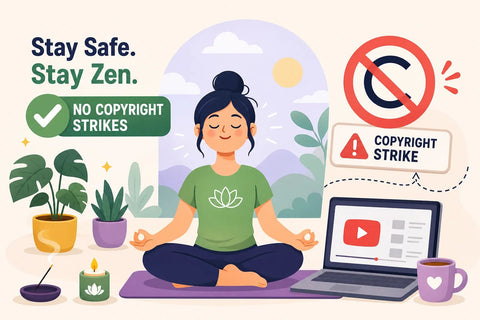
Yes, often — but only if the license for that specific track allows modification and your final use stays inside the license. “Royalty-free” usually means you do not owe ongoing royalties for approved uses; it does not mean you own the music or can edit, sell, or redistribute it without limits. If the license allows adaptation, syncing, or editing, looping meditation music is commonly permitted. If the license says no derivatives, noncommercial only, or no standalone audio distribution, then editing and sharing the looped version may not be allowed. At Meditation Music Library, our license is written in plain language and explicitly covers the kinds of edits meditation creators need — trimming, looping, fading, and combining with voiceover — so you can work with confidence.

What does the answer depend on?
The real issue is not whether the music is labeled “royalty-free.” The real issue is what the track license says. Royalty-free means you can use licensed content without paying ongoing royalty fees, but the use is still controlled by contract terms. That is why two “royalty-free” tracks can have very different rules. One license may allow commercial adaptations, another may allow edits only for noncommercial use, and another may forbid shared derivatives entirely.
Some tracks are released under flexible open licenses such as CC BY or CC0, while others come from stock-music libraries with narrower platform or media restrictions. At Meditation Music Library, we have written our End User License Agreement to be clear and specific about what editing is allowed — so you never have to guess.
What counts as editing or looping?
From a copyright and licensing perspective, cutting, extending, rearranging, looping, fading, or rebuilding a track with stems is usually best understood as modifying the original work. The U.S. Copyright Office treats musical arrangements and other modifications as classic examples of derivative works, and Creative Commons defines adapted material as content that has been altered, arranged, transformed, or otherwise modified when permission is needed.
In practice, that means a simple meditation-music workflow — such as trimming the intro, looping a calm middle section, and fading it under spoken guidance — should be treated as an adaptation unless the license clearly says otherwise. That matters because some licenses allow adaptations, some allow them only for noncommercial uses, and some allow you to make them privately but not share them publicly.
When can you usually do it?
You can usually edit or loop royalty-free meditation music when the license expressly allows modification and the music stays part of a larger permitted project. Typical allowed uses often include these kinds of edits:
- Looping a soft ambient section under a guided meditation video when the license covers audiovisual use.
- Trimming a long intro and adding a fade under spoken guidance for a podcast or course, if the license permits those distribution formats.
- Using stems to stretch a short music bed into a longer breathing or mindfulness session, if the provider expressly allows stem-based rearrangement.
Open licenses can also permit this, but the exact license matters. CC BY and CC BY-SA allow remixing, adapting, and even commercial use, provided attribution is given. CC BY-NC and CC BY-NC-SA allow adaptation only for noncommercial use. CC0 is the most flexible because the rights holder waives rights as broadly as possible. If you modify a CC BY work, version 4.0 also requires you to indicate that changes were made.
At Meditation Music Library, our license explicitly permits you to trim, extend, loop, and combine our music with voiceover, sound effects, binaural beats, and nature sounds as part of your own project. This is the kind of clarity that general royalty-free libraries often lack.
When is it not allowed?
It is usually not allowed when the license blocks shared adaptations, limits the medium, or bans standalone music distribution. CC BY-ND and CC BY-NC-ND permit sharing only in unadapted form, so a publicly shared looped version would normally fall outside those licenses.
It is also a problem when your finished output is basically the music itself rather than a larger project that uses the music. Many stock-audio licenses specifically prohibit uploading audio files, or portions of them, to digital streaming platforms or public music directories as standalone content.
Common red flags include:
- Releasing your looped meditation track as your own relaxation single, album, or download.
- Selling the edited music file by itself, even if you added fades or extra instruments.
- Using a noncommercial license in a paid app, paid course, or monetized product.
- Assuming a platform-friendly license also covers CDs, DVDs, video games, TV, or radio.
Our license at Meditation Music Library is equally clear on what is not allowed: you cannot sell or distribute the music as a standalone audio product, claim the music as your own, or register it with Content ID systems. These boundaries protect both you and the composers who create the music.
What music works best for looping and editing in meditation projects?
Not all music is equally suited to looping and editing for meditation use. Tracks composed specifically for meditation — with sustained ambient textures, gradual dynamics, and no abrupt transitions — loop far more naturally than general commercial music. This is one of the core reasons Meditation Music Library exists: every track is composed with the meditation creator’s workflow in mind.
Here are some of our collections that are particularly well-suited for looping, editing, and layering in guided meditation and mindfulness projects:
- Pure Binaural Tones — MEGA Bundle — our most comprehensive binaural tones collection, ideal for creators who layer tones under voiceover or loop sustained frequencies for breathwork, sleep, and deep meditation sessions
- Pure Binaural Tones — Theta Waves Bundle — theta-frequency tones designed for deep relaxation and meditation; their sustained, seamless nature makes them exceptionally easy to loop
- Pure Binaural Tones — Delta Waves Bundle — slow delta-wave tones perfect for sleep meditations and yoga nidra recordings where long, uninterrupted audio is essential
- Serenity — Part I & II — expansive, flowing ambient soundscapes that blend seamlessly when looped, ideal as a background for longer guided meditation recordings
- Meditate & Relax Vol. 3 — Bestseller Collection — our latest bestseller bundle featuring a versatile range of tracks that work across multiple meditation formats and editing styles
Each purchase comes with a clear commercial license that explicitly permits trimming, looping, and combining with voiceover — exactly the workflow most meditation creators need.
What does our license allow for editing and looping?
Our End User License Agreement is written specifically for meditation and mindfulness creators. Here is what it says about editing:
✅ Permitted editing uses:
- Trim, shorten, extend, or loop the music within your project
- Add voiceover, sound effects, binaural beats, nature sounds, and frequencies
- Combine the music with your own spoken guidance, affirmations, or instruction
- Use the edited version in guided meditations, podcasts, YouTube videos, courses, and apps (with voiceover)
- Sell and monetize the finished product as long as your own creative content is the primary element
❌ Not permitted:
- Distributing the edited or looped music as a standalone audio product
- Claiming the music or your edited version as your own original composition
- Registering the content with Content ID or sync licensing systems
- Creating subliminal recordings where your voice is inaudible
For audio-only projects, at least one-third of the recording must include voiceover or speech. For video content, voiceover is optional. For the full terms, visit our End User License Agreement or contact us at narek@musicofwisdom.com.
How do you check a track safely before publishing?
Use a simple license check every time. Read the exact track license, not just the marketplace homepage. Look for terms such as adapt, modify, derivative works, loop, cut, stems, and synchronize. Then check whether your destination format is allowed: video, podcast, app, e-course, ad, streaming service, downloadable audio file, or something else.
A safe workflow looks like this:
- Confirm whether editing is allowed at all.
- Confirm whether your use is commercial or noncommercial.
- Confirm whether the music must remain inside a larger project instead of being distributed by itself.
- Confirm whether attribution is required and whether you must note changes.
- Save a copy of the license terms and follow any provider-specific credit or claim instructions.
When you purchase from Meditation Music Library, your license documentation is stored in your account, so you always have proof of your permitted use if a platform or distributor asks.
What mistakes should you avoid?
The biggest mistake is assuming “royalty-free” means “free of restrictions.” It does not. Another common mistake is thinking that a basic edit — like trimming the first 10 seconds or looping a calm section — turns the music into your own original asset. It usually does not; the original copyright remains with the rights holder, and your permission still comes from the license.
Creators also get into trouble by ignoring ND and NC terms, failing to credit CC-licensed music properly, or redistributing edited music as a product instead of as part of a larger project. In short, the safest rule is this: edit the track only as much as the license allows, and keep the music inside the kind of project the license actually covers. Choosing music from a library like Meditation Music Library — where the license is written specifically for meditation creators — removes most of this uncertainty from the start.
FAQ
Can I loop a 30-second section of royalty-free meditation music?
Usually yes, if the license allows modification or synchronization. At Meditation Music Library, our license explicitly permits looping sections as part of a larger meditation project.
Can I add voiceover to royalty-free meditation music?
Often yes, because many licenses are designed for music used inside larger audiovisual, podcast, or course projects. Our license at Meditation Music Library is specifically designed for this use case — voiceover-led guided meditations are one of the primary permitted uses.
Can I upload my edited meditation track to streaming services?
It depends on the license. Our license at Meditation Music Library permits uploading to platforms like Spotify, Insight Timer, and YouTube — as long as your product includes meaningful voiceover and the music is not the primary element being sold.
If a track is CC BY, can I edit it?
Yes. CC BY allows remixing and adapting, including commercially, but you must give attribution and indicate changes under version 4.0.
If a track is CC BY-ND, can I loop it and publish it?
No, not as a shared edited version. CC BY-ND allows sharing only in unadapted form.
Is CC0 the safest option if I need heavy editing?
Usually yes for maximum flexibility, but CC0 music is rarely composed specifically for meditation. Tracks from Meditation Music Library offer a clear commercial license and music that is purpose-built for the practice — a better combination for most creators.
Does royalty-free mean public domain?
No. Royalty-free usually means no ongoing royalty payments for licensed uses, while public-domain or CC0 material is a different legal situation with much broader reuse rights.
Can I loop Meditation Music Library tracks for a sleep meditation I plan to sell?
Yes. Our license covers looping and editing for guided meditations you sell, including sleep meditations. The Pure Binaural Tones — Delta Waves Bundle is particularly well-suited for this use case.