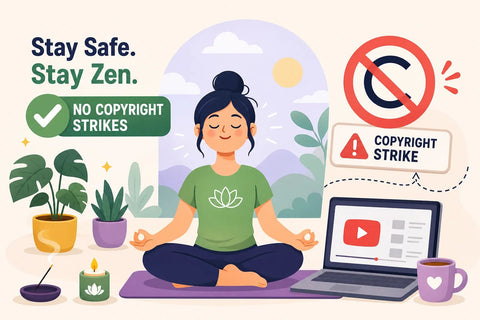
Not necessarily. “Royalty-free” means you don’t owe ongoing payments, but copyright still belongs to the creator. Whether you must credit the artist depends entirely on the license. Many paid royalty-free libraries do not require attribution, while some free or Creative Commons tracks do. Always check the specific license. At Meditation Music Library, our license does require attribution — but we’ve made it simple and clear exactly how to do it, so there is no guesswork.

What Is “Royalty-Free” Music?
-
Definition: Royalty-free music is a licensing model. You pay once (or subscribe) and can then use the music without paying per use. It does not mean “copyright-free.” The composer or copyright holder still owns the work. You must follow the license terms under which the music was provided.
-
Usage: After obtaining a royalty-free license, you can include the track in videos, podcasts, ads, etc., as permitted by the license. This one-time payment covers usage rights.
Key point: Royalty-free only describes payment; it does not automatically waive credit or other conditions. You must read the license or terms for each track. This is true of our music at Meditation Music Library as well — our End User License Agreement is clear about what attribution is required and how to provide it.
License Terms and Attribution
Whether you need to credit the artist comes down to the license conditions:
-
Paid Stock Libraries and Subscriptions: Many paid subscription services typically include a broad license and do not require attribution. However, this varies by provider — always read the specific terms rather than assuming.
-
Creative Commons (CC) and Free Licenses: Many free music resources use Creative Commons licenses. All CC “Attribution” licenses (BY, BY-SA, etc.) require credit. A CC BY license legally obligates you to give proper credit to the creator. Skipping it could lead to copyright claims.
-
Public Domain or CC0: Music in the public domain or under CC0 has no copyright or attribution requirement. You may credit the artist as a courtesy, but it’s not legally required. However, truly copyright-free music is rare.
-
Meditation Music Library: Our license requires attribution. You must credit “Music of Wisdom” and link to meditationmusiclibrary.com whenever you use our music. We provide specific credit formats for different platforms — YouTube, Insight Timer, social media, digital downloads, and more — in our End User License Agreement. If you are unable to credit us for any reason, contact us at narek@musicofwisdom.com and we will try to accommodate your request.
How to Check If Credit Is Required
-
Read the License or Terms: Before using any track, review the license text or FAQ. Look for phrases like “No attribution required” or “No credit needed.” If the site or license says “must credit artist/author,” you must comply.
-
Check the Download Page: Many royalty-free platforms flag tracks that require credit. If a track needs credit, it often appears in the download info or on the page next to the track.
-
Creative Commons Icons: Watch for CC icons. CC BY and CC BY-SA = credit required. CC0 = credit not required.
-
Ask or Search FAQs: If unclear, search the site’s FAQs or support. At Meditation Music Library, our End User License Agreement has a dedicated section on credit with platform-specific examples.
Checklist: Has the provider explicitly waived the requirement? If not, assume you may need to credit and confirm in writing.
When Must You Credit the Artist?
Situations that typically require attribution include:
-
Creative Commons “BY” Licenses: CC BY, BY-SA, BY-NC, etc. Always credit “author – Title (source/link)” as per CC rules.
-
Free Track Licensing with Attribution Clauses: Some artists release music on royalty-free sites under a “free license” that asks for credit in lieu of payment. Ignoring this can lead to claims.
-
Meditation Music Library: Our license requires credit in all cases. The specific format depends on the platform — see the Credit section of our End User License Agreement for exact wording per platform.
Conversely, you usually do NOT have to credit if:
-
You Purchased a Premium License from a No-Attribution Library: Some one-time licenses or subscriptions include broad usage rights that explicitly waive attribution. Always verify this in writing.
-
CC0 or Public Domain: If the music is truly free of copyright or under CC0, no attribution is legally needed (but you may credit as courtesy).
How to Credit Meditation Music Library
Our End User License Agreement provides specific credit formats for each platform. Here is a summary:
-
YouTube & Video Platforms: Add a credit line in the video description: “[Title of Music] composed by Music of Wisdom — Licensed from https://meditationmusiclibrary.com/”
-
Insight Timer: Add Music of Wisdom as a contributor (composer) on your track page.
-
Social Media: Credit in the description or tag us: Facebook @musicofwisdom • Instagram @music_of_wisdom • TikTok @musicofwisdom • LinkedIn @musicofwisdom
-
Digital Downloads / MP3: Add a meta tag for the composer: “Music of Wisdom.”
-
CD & DVD: Add a credit on the back cover: “[Title of Music] composed by Music of Wisdom — Licensed from https://meditationmusiclibrary.com/”
If you are unable to credit us for any reason, contact us at narek@musicofwisdom.com and we will try to accommodate your request.
How to Give Credit (General Best Practices)
If the license requires attribution, follow best practices (often summarized as TASL for Title, Author, Source, License):
-
Title: Name of the track (if available).
-
Author/Artist: Name of the composer or performer.
-
Source: Where you got it (e.g. website or library name, with a link if online).
-
License: Mention the license (e.g. “CC BY 4.0” with a link).
Example credit line (for a CC BY track):
“Song Title by Artist Name, from [Platform], used under CC BY 4.0.”
For Meditation Music Library music, use the platform-specific formats listed in our End User License Agreement. The credit is simple, takes one line, and ensures you are fully compliant with your license.
Benefits of Crediting (Even When Optional)
Even if your license doesn’t require it, giving credit can be good practice:
-
Ethics and Goodwill: It’s a courtesy that supports creators. When you credit Music of Wisdom, you are supporting the composers who dedicate their work to the meditation and mindfulness community.
-
Discoverability: Fans of your content can find the music by looking up the artist or track you list — and may become customers of Meditation Music Library themselves.
-
Transparency: It shows your audience and clients you respect copyright law, which builds trust.
-
Protection: Proper metadata can help music ID systems match your usage to the license, which may help resolve disputes.
Our Music — Built for Creators Who Want Clarity
One of the most common frustrations for meditation and mindfulness creators is not knowing exactly what their music license allows — and whether they need to credit, and how. At Meditation Music Library, we have written our license to remove that uncertainty. The attribution requirement is clear, the format is specified per platform, and the music itself is composed specifically for meditation, yoga, and mindfulness use.
Here are some of our most popular collections, trusted by creators around the world:
-
Meditate & Relax Vol. 1 — Bestseller Collection — our original bestseller bundle, featuring the tracks that put Meditation Music Library on the map; versatile enough for any meditation or mindfulness project
-
Power of Gratitude — Meditation Music Collection — warm, heart-centred compositions ideal for gratitude meditations, affirmation recordings, and positive mindset content
-
Choral Meditation Music — Bundle — sacred, choir-infused soundscapes that bring a devotional, uplifting quality to spiritual content and guided meditations
-
Morning Meditation Music — Bundle — gentle, uplifting tracks perfect for morning routines, affirmation videos, and sunrise practices
Every purchase includes a clear commercial license with straightforward attribution requirements — no subscription, no recurring fees, no ambiguity.
Common Mistakes to Avoid
-
Assuming “Royalty-Free” Means No Credit: Royalty-free only refers to payment, not attribution. Always verify the license terms. Our music requires credit — but we make it easy.
-
Ignoring “Free” Music Fine Print: Many free tracks on sites or YouTube claim “no copyright,” but they may be CC-BY. Failing to read that can get you a claim.
-
Using Credit from Old Videos: If you use a track multiple times, some services require a fresh credit line for each video. Don’t copy an old attribution that’s no longer valid.
-
Neglecting Platform Policies: Some platforms (YouTube, Twitch, etc.) have automated ID systems. Even licensed music can trigger a claim if not documented properly. Make sure your license covers each platform and that you’ve followed any clearance procedures.
-
Not Keeping License Records: Always save your purchase receipt and a copy of the license terms. At Meditation Music Library, your purchase history is stored in your account.
How to Check License Details
-
Always download from official sites: Use the library or website that clearly issues the license. Keep records (invoices or license PDFs).
-
Use License Filters: On sites like YouTube Audio Library or Free Music Archive, filter for “Attribution required” or “No attribution.”
-
Contact Support: If unsure, ask the provider’s support. At Meditation Music Library, you can reach us at narek@musicofwisdom.com.
-
Read the Legal Code: If you’re really thorough, Creative Commons licenses have full legal texts available at creativecommons.org.
FAQ
Q: Does paying for a music license automatically waive the need to credit?
A: Not always — it depends on the specific license. Some paid libraries waive attribution entirely; others, like Meditation Music Library, require a simple credit line. Always read the license before assuming.
Q: Do I have to credit if I use Creative Commons music?
A: If it’s a CC BY or similar license, then yes — CC BY means “Attribution.” You must credit the artist as specified by that license. If the music is CC0 (public domain waiver), then no credit is legally required, though you can give it as a courtesy.
Q: Do I need to credit when using Meditation Music Library music?
A: Yes. Our license requires you to credit “Music of Wisdom” and link to meditationmusiclibrary.com. We provide specific credit formats for YouTube, Insight Timer, social media, digital downloads, and other platforms in our End User License Agreement. If you cannot credit us for any reason, contact us at narek@musicofwisdom.com.
Q: What if the license says “Must credit in description” but I forget?
A: If you fail to credit as required, the copyright holder could file a claim or you could be in breach of the license. The remedy is to add the credit and, if a claim has been filed, dispute it with proof of your license. Always follow the instructions carefully for “must credit” licenses.
Q: How do I properly format a music credit?
A: A good format is “‘Song Title’ by Artist Name (source — e.g. Platform or licensor), licensed under [License Name].” For Meditation Music Library music, use: “[Title of Music] composed by Music of Wisdom — Licensed from https://meditationmusiclibrary.com/”
Q: Can I just credit on-screen (e.g. end credits) instead of the description?
A: Yes, visible credits on video work too. A final slide listing “Music: [Title] by Music of Wisdom, licensed from meditationmusiclibrary.com” is acceptable. If the license specifically says “include in video description,” follow those instructions.
Q: I found a “royalty-free” track on YouTube claiming free use – do I still need to credit?
A: Definitely check the actual license. Many YouTube channels that offer “free music” are distributing CC-licensed content. Even if the uploader says “use this however,” the underlying license (often CC BY) may require you to credit the composer. Always confirm via the source link or license info.
Q: What happens if I don’t credit when I should?
A: You could face a copyright claim, takedown, or legal notice. If a platform’s automated system detects uncredited use, your video could be demonetized or removed. The safest path is to credit when required, and when in doubt, credit voluntarily.
Q: Is it bad to credit even if not asked?
A: Not at all. Credit never hurts and can only help. It shows respect, may expose viewers to new music, and can prevent misunderstandings. Just be concise — one line in the description or end credits is usually enough.